
In 2026, the modern kitchen is reshaping how storage is planned, from smarter layouts to more efficient wall-mounted cabinet for kitchen solutions. For buyers, builders, and homeowners, choosing the right kitchen cabinet manufacturer is no longer just about style, but also about maximizing space, function, and long-term project value.
Across residential projects, apartment developments, villas, and renovation programs, storage planning has become a performance issue as much as a design issue. A kitchen that looks clean on day one but fails under daily use within 12 to 24 months creates callbacks, user complaints, and avoidable retrofit costs. That is why procurement teams and project managers now evaluate cabinet systems by layout efficiency, hardware durability, installation coordination, and future adaptability.
For companies working in building decoration materials, the shift is especially important. Cabinet systems now need to support tighter urban floor plans, more appliances, higher expectations for organization, and faster project schedules. Kucu Building Materials Co., Ltd., based in Foshan, Guangdong, China, operates a 40,000 square meter manufacturing center with 8 high-configuration production lines and 20 years of experience in customized cabinets, combining production, design, and export support for builders, design firms, decoration companies, and building owners.
This article explains the main modern kitchen trends that are changing storage planning in 2026, what they mean for cabinet selection, and how buyers can make better decisions on material, configuration, and supplier cooperation.
Why 2026 Kitchen Storage Planning Starts with Space Efficiency
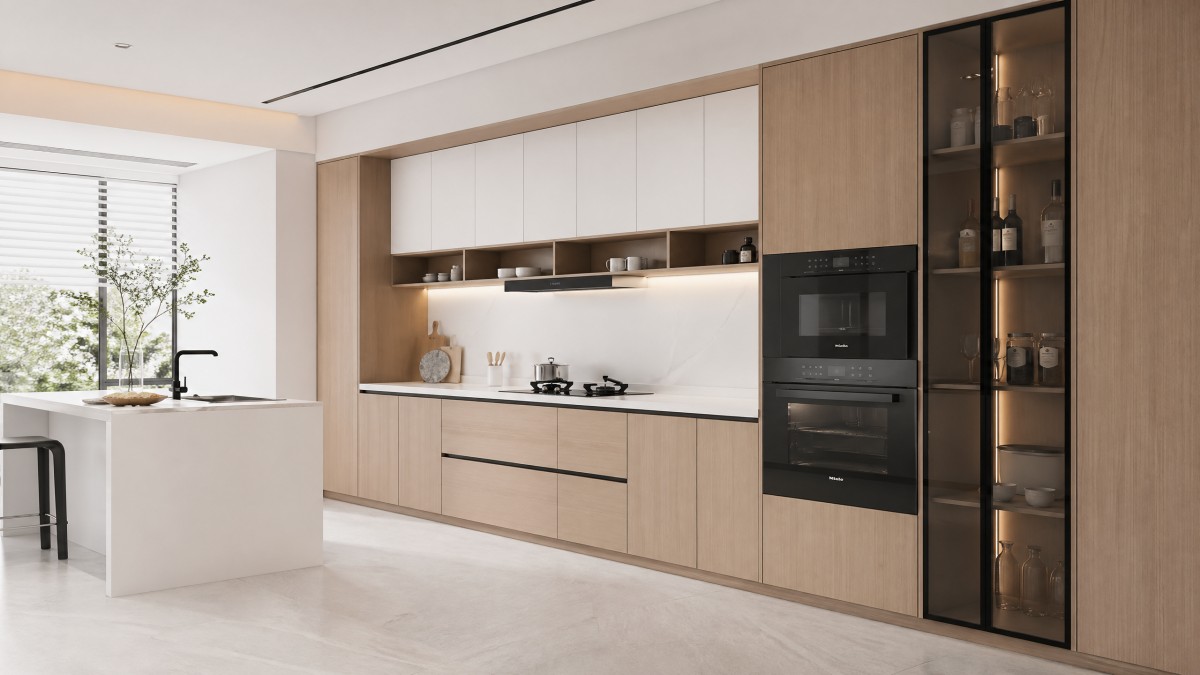
Space efficiency is now the first filter in modern kitchen planning. In many new apartments, kitchen footprints remain within 6 to 12 square meters, while the number of required storage functions keeps increasing. Users want room for cookware, dry goods, small appliances, cleaning supplies, recycling bins, and often decorative display space as well. Without a structured storage plan, even premium cabinet finishes cannot solve workflow problems.
This is why wall-mounted cabinet for kitchen designs are gaining more attention in 2026. They extend usable storage vertically, keep countertops cleaner, and support faster cleaning routines. For project developers, vertical storage can improve perceived value without expanding the floor area. For distributors and end users, it often means better daily convenience with only moderate material cost increases.
From a project execution view, storage planning should start before finish selection. The basic sequence usually includes 4 steps: defining user habits, mapping appliance sizes, confirming cabinet module dimensions, and checking installation clearances. A common mistake is selecting door style first and internal configuration later. That approach often reduces practical capacity by 10% to 20% because the cabinet shell is not optimized for baskets, drawers, or corner mechanisms.
Buyers should also consider how often the kitchen will be used. A family kitchen, rental apartment kitchen, and hospitality pantry have different storage stress levels. High-frequency kitchens may require drawer runners and hinges tested for heavier use cycles, stronger shelf load performance, and easier access in blind corners. Storage planning in 2026 is therefore not only about adding more cabinets, but also about matching storage form to actual use intensity.
Key Drivers Behind the Shift
- Smaller urban layouts require more vertical and corner storage utilization.
- Built-in appliances reduce free cabinet space and demand tighter dimension control.
- Open-plan living increases the need for cleaner lines and concealed storage.
- Owners increasingly expect multi-zone organization instead of one large general cabinet.
The following comparison shows why traditional cabinet planning often underperforms when compared with 2026-oriented storage layouts.
The key conclusion is simple: when storage planning is treated as a technical and operational task rather than a decorative afterthought, the kitchen performs better over its full service life and supports stronger client satisfaction.
The Cabinet Trends Reshaping Modern Kitchens
Several cabinet trends are influencing how storage is planned in 2026. The first is modular zoning. Instead of using long uninterrupted cabinet runs, designers now divide the kitchen into 3 to 5 functional zones, such as preparation, cooking, washing, food storage, and display. This improves retrieval speed and reduces unnecessary movement during daily use.
The second trend is deeper integration of tall units and semi-open storage. Tall pantry cabinets can centralize dry goods and appliance storage, while selective open niches create easier access for frequently used items. However, these niches should be used carefully. In projects with heavy dust exposure or high turnover, too much open storage can increase maintenance needs and reduce visual consistency.
The third trend is slimmer visual design with stronger internal function. Flat-panel doors, concealed handles, and neutral finishes remain popular, but inside the cabinet, buyers increasingly request pull-out trays, drawer inserts, tray dividers, and lift-up systems. Some projects also extend kitchen storage planning into adjacent spaces using pantry walls or utility transitions. In these mixed-use layouts, a feature such as a Liquor cabinet may be added to connect cooking, dining, and entertaining zones without disrupting the core storage flow.
Another strong shift is the demand for installation-friendly prefabrication. Cabinet manufacturers that can pre-confirm hole positions, appliance clearances, and panel dimensions help reduce on-site adjustment time. For project managers, shaving even 1 to 2 days off kitchen installation in multi-unit developments can improve handover coordination and reduce labor overlap with electrical and countertop teams.
How These Trends Affect Buyers
What procurement teams should verify
- Whether cabinet modules can be adjusted in common width ranges such as 300mm, 450mm, 600mm, and 900mm.
- Whether internal accessories are optional by project budget instead of fixed into one package.
- Whether wall-mounted cabinet loads and fixing methods are suitable for the substrate condition.
- Whether the supplier can coordinate design drawings, production, packing, and export timing in one workflow.
To support selection, the table below outlines practical cabinet trend impacts on storage planning and project delivery.
These trends are not only visual preferences. They directly affect project coordination, end-user convenience, and after-sales risk. That is why trend awareness must be connected to measurable cabinet planning decisions.
Material, Structure, and Hardware Choices That Support Better Storage
A good storage plan will fail if materials and hardware are selected only by initial price. In kitchen environments, heat, humidity, grease, and repeated opening cycles create long-term stress. For many projects, buyers compare panel categories such as moisture-resistant boards, plywood-based structures, or other engineered panels depending on budget level, local climate, and installation environment. The decision should be linked to use conditions rather than a one-size-fits-all assumption.
Hardware is equally important. Hinges, runners, lift systems, and pull-out accessories determine how efficiently storage performs over time. A drawer that sticks, tilts, or loosens after 18 months can damage the user’s impression of the whole kitchen. For higher-traffic kitchens, it is practical to review load ratings, smoothness, and replacement accessibility before order confirmation. Even when exact cycle data varies by supplier, buyers should ask for hardware grade consistency across the batch.
Structural detailing also matters. Shelf spacing, toe-kick height, back panel fixing, and corner cabinet design influence real storage value. For example, a deep base cabinet with only one internal shelf may look spacious on paper but is often less usable than a multi-drawer unit. Similarly, overhead cabinets installed too high may add capacity but reduce practical access for many users. In most residential kitchens, access comfort usually improves when high-use storage stays within an ergonomic reach zone rather than at the topmost level.
For decorative and mixed-use layouts, some developers also integrate adjacent storage features beyond the main cooking line. A carefully placed Liquor cabinet can serve as a transition piece between kitchen and dining space, but it should not compromise circulation width or core food-preparation storage. The priority remains workflow first, specialty storage second.
Recommended Evaluation Points
- Check whether cabinet boards and edge treatment are suitable for humid kitchen conditions.
- Review hinge and runner consistency across all modules, not only sample units.
- Confirm whether wall cabinet fixing details are matched to concrete, brick, or light wall substrates.
- Ask about spare parts availability for at least the normal maintenance cycle of the project.
In short, better storage performance is built through a combination of panel choice, hardware quality, dimension logic, and installation compatibility. These are the practical foundations behind modern kitchen trends.
How Buyers and Project Managers Should Select a Kitchen Cabinet Manufacturer
Selecting a kitchen cabinet manufacturer in 2026 requires more than reviewing a catalog. Buyers need to assess whether the supplier can support design coordination, production stability, packaging accuracy, and export communication in one chain. For builders and decoration companies, fragmented supply often creates avoidable delays between drawing approval, factory release, shipment, and on-site installation.
A capable manufacturer should be able to discuss both aesthetics and execution details. That includes cabinet layout optimization, module customization, material suggestions, and realistic lead-time planning. Kucu Building Materials Co., Ltd. combines production, design, and export capabilities, which is particularly relevant for overseas procurement teams that need one partner to manage multiple stages rather than separate contractors for each step.
When comparing suppliers, decision-makers should ask specific questions. How are dimensions confirmed? How are revisions managed? What packing methods are used for long-distance shipment? How are missing parts handled? A strong answer is usually process-based, not promotional. For example, a supplier that can define drawing review checkpoints in 3 stages and explain standard production sequencing is often more reliable than one that only promises quick delivery.
Scale can also matter when projects involve repeat units or mixed product categories. A manufacturer with a 40,000 square meter manufacturing center and 8 production lines may be better positioned to support stable output across kitchen cabinets, wardrobes, and bathroom vanity programs, especially when project schedules require coordinated deliveries instead of isolated orders.
Supplier Selection Checklist
The table below helps procurement teams compare cabinet manufacturers based on practical project needs rather than surface-level claims.
The strongest manufacturer is not necessarily the one with the broadest brochure. It is the one that can align design intent, manufacturing precision, and delivery execution with your project’s actual storage goals.
Implementation Risks, Common Mistakes, and Practical Planning Advice
Even with a modern kitchen concept, storage planning can fail if common risks are ignored. One frequent issue is overfilling the upper zone. Adding too many overhead cabinets may increase theoretical capacity, but if daily-use items are stored above comfortable reach, users simply avoid them. Another issue is underestimating appliance dimensions, especially when ovens, dishwashers, refrigerators, and range hoods come from different brands with slightly different installation requirements.
A second mistake is treating every project the same. A developer-grade apartment kitchen may prioritize cost control, standardized modules, and fast repeat installation. A private villa project may place more value on full customization and specialty storage. A distributor serving multiple markets may need flexible finish options and flat-pack efficiency. Storage planning should therefore respond to the business model, not just the room shape.
Lead time planning is another area where buyers can reduce risk. A typical cabinet project usually passes through at least 5 stages: requirement collection, drawing confirmation, material and finish approval, production, and shipping or installation coordination. Delays often occur when dimension checks are incomplete or when revisions continue after production scheduling. Early coordination can save far more time than last-minute acceleration.
The safest approach is to create a practical storage matrix before order release. Define what must be stored, where it should be accessed, and how frequently each category is used. This helps avoid expensive visual choices that do not improve function.
Common Risk List
- Ignoring wall conditions when specifying heavy wall-mounted cabinet for kitchen systems.
- Using too many fixed shelves instead of drawers in lower cabinets.
- Confirming countertop and cabinet dimensions without appliance model checks.
- Choosing finishes first and internal organization later.
- Leaving no allowance for installation tolerance, service access, or future maintenance.
FAQ for buyers in 2026
How do I know if more wall cabinets are a good idea?
They are beneficial when floor area is tight and wall structure can support secure fixing. The right solution depends on user height, access frequency, and hood layout. More upper cabinets are useful only if they remain accessible and do not overcrowd the room.
What should I prioritize when selecting a kitchen cabinet manufacturer?
Look at customization ability, design communication, production consistency, and export or delivery coordination. A good supplier should answer with process details, not only visual samples.
Is custom storage planning worth it for multi-unit projects?
Yes, when customization is controlled through modular standards. Standardized customization often improves layout fit and reduces long-term complaints without creating unmanageable production complexity.
How early should storage planning start?
Ideally during layout and appliance coordination, before final finish approval. Starting early reduces revision costs and supports smoother coordination with electrical, plumbing, and countertop teams.
Modern kitchen trends in 2026 are changing storage planning from a style discussion into a full project decision covering layout, hardware, materials, installation, and long-term usability. For procurement personnel, business decision-makers, project managers, distributors, and homeowners, the best results come from balancing visual design with practical storage performance, reliable manufacturing, and clear delivery coordination.
With 20 years of customized cabinet experience, integrated production, design, and export capabilities, and a broad offering that includes kitchen cabinets, wardrobes, and bathroom vanity solutions, Kucu Building Materials Co., Ltd. can support projects that require both flexibility and execution discipline. If you are planning a 2026 kitchen project, contact us now to get a customized cabinet solution, discuss product details, and explore storage layouts that create lasting value for your project.