Custom Kitchen Cabinets & Whole House Cabinetry Manufacturer in China
KUCU is a China-based manufacturer providing custom kitchen cabinets, wardrobes and whole-house cabinetry for global residential and commercial projects.About KUCU.
Can KUCU provide kitchen cabinets design services?? Absolutely—and far beyond standard planning. KUCU supports custom kitchen cabinet layouts with AI-powered 3D design, eco-certified materials, and full-service project coordination from production to delivery. For homeowners, designers, and contractors exploring tailored cabinetry solutions, KUCU offers a practical way to turn unique space requirements into efficient, export-ready kitchen designs.
What does KUCU actually provide for custom kitchen cabinet layouts?
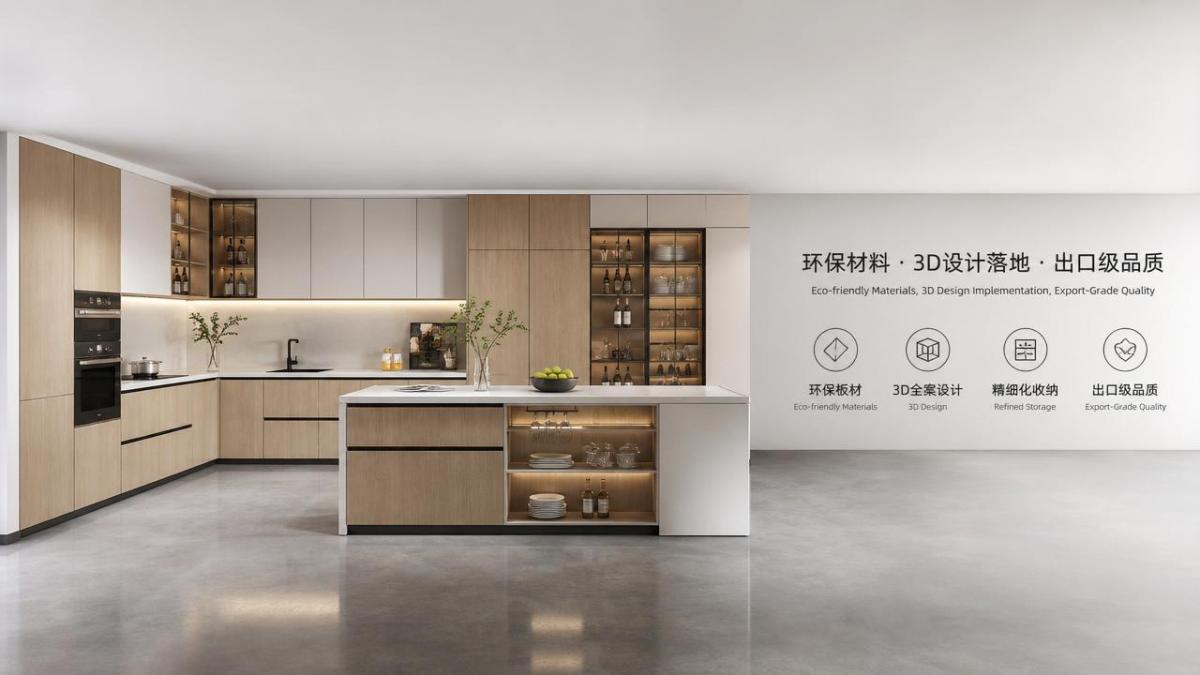
When buyers ask, “Can KUCU provide kitchen cabinets design services?” the real question is usually broader. They want to know whether the supplier can handle layout planning, storage optimization, material compliance, production accuracy, and overseas delivery without creating extra coordination risk. In that context, KUCU functions as more than a cabinet factory.
Foshan KUCU Building Materials Co., Ltd. provides custom whole-home cabinetry solutions for export markets, especially North America and Australia. For kitchen projects, the service scope typically covers measurement-based design input, cabinet configuration, 3D visualization, board and finish selection, hardware matching, production, shipment coordination, customs-related export handling, and installation support.
This matters because custom layouts are rarely just about fitting cabinets along a wall. Real projects involve corner transitions, appliance clearances, sink and cooktop positioning, ventilation routes, traffic flow, pantry access, and code-conscious material choices. A supplier that only manufactures boxes after receiving drawings is very different from one that supports design decisions from the start.
- AI-powered 3D design tools that help clients visualize cabinet arrangements before production begins.
- Design completion within 7 days for projects that require fast review and revision.
- Material options based on CARB P2 and FSC-certified formaldehyde-free boards for markets with strict environmental expectations.
- End-to-end export support that reduces the gap between design intent and delivered product.
For information-stage buyers, this integrated model is often the difference between a smooth custom cabinet project and one that becomes fragmented across designers, manufacturers, freight providers, and installers.
Which kitchen scenarios benefit most from KUCU design services?
Not every kitchen needs the same design logic. Some projects prioritize space efficiency, while others focus on premium finishes, rental durability, or compliance with local environmental requirements. The strongest answer to “Can KUCU provide kitchen cabinets design services?” comes from looking at use cases.
The table below shows where a custom design service adds practical value in real kitchen layouts rather than only aesthetic variation.
In practical terms, KUCU’s design services are especially useful when a kitchen cannot rely on off-the-shelf cabinet modules alone. That includes L-shaped, U-shaped, galley, island, and open-plan kitchens where every inch affects circulation, storage, and installation fit.
Typical buyers who need layout support
- Homeowners who want a kitchen designed around exact cooking, storage, and family-use habits.
- Interior designers who need a manufacturer able to translate concept drawings into production-ready cabinetry.
- Builders and developers who need export-capable kitchen cabinet solutions with repeatable quality and predictable lead times.
How KUCU compares with standard cabinet supply models
Many buyers researching custom kitchens are comparing several supply paths at once: local cabinet shops, stock cabinet retailers, semi-custom suppliers, and overseas manufacturers. To evaluate whether KUCU can provide kitchen cabinets design services in a meaningful way, it helps to compare the service model rather than just the product category.
The following comparison highlights differences that affect project risk, revision efficiency, and procurement clarity.
The key difference is integration. Buyers do not need to split design, compliance checks, manufacturing, and shipping into separate disconnected tasks. That is particularly important for overseas projects, where one drawing error or missing specification can delay the entire kitchen installation schedule.
What should buyers review before requesting a custom kitchen cabinet design?
A good design service works best when the project brief is complete. Buyers who prepare accurate input usually receive faster, more usable proposals. This is true whether the project is a private home renovation in California, a condo project in Toronto, or a residential development in Sydney.
Recommended pre-design checklist
- Provide room dimensions, ceiling height, window and door positions, and any structural columns or irregular wall conditions.
- Confirm appliance sizes early, including refrigerator depth, oven width, dishwasher opening, and range hood requirements.
- Clarify usage priorities such as pantry storage, island seating, hidden waste bins, spice pull-outs, or tall broom cabinets.
- Identify compliance expectations for the destination market, especially if CARB Phase 2 or FSC-related documentation is required.
- Discuss delivery timing, installation sequence, and whether the project is a one-time home order or a multi-unit contractor schedule.
These details help KUCU turn a broad request into a realistic proposal. They also reduce revision cycles, which is critical for buyers working under renovation deadlines or contractor milestones.
Common decision factors during cabinet design selection
The right kitchen layout is not only the one that looks best in a rendering. It must also work with maintenance expectations, family routines, and installation conditions. Buyers should evaluate both visible and hidden factors.
- Board specification and environmental compliance for the target country.
- Door style and hardware practicality, especially in tight circulation zones.
- Storage efficiency per linear meter, not just total cabinet count.
- Lead time from design approval to production and shipment.
- Clarity of drawings, labeling, and installation support for overseas assembly.
How do materials, compliance, and hardware affect the final kitchen plan?
For building and decorative materials, layout design cannot be separated from material decisions. A kitchen may look refined in a rendering, but if the board specification does not meet the project’s environmental requirements, or the hardware is not suited to the space, the design loses value quickly.
KUCU emphasizes CARB P2 and FSC-certified formaldehyde-free boards, which is relevant for North American and Australian buyers who want documentation aligned with common market expectations. This is particularly important for residential developments, remodels involving indoor air quality concerns, and projects where contractor procurement must pass review.
Hardware choices also influence layout performance. Patented solutions such as Bi-Fold Doors, trackless sliding systems, and concealed hardware can improve access and movement in compact homes. In narrow kitchens or apartments with constrained circulation, these details can have a more practical impact than surface finish upgrades alone.
Buyers should not treat design, board specification, and hardware as separate conversations. The most efficient kitchen cabinet design service integrates all three early, so the final quotation and production drawings reflect what will actually be manufactured and installed.
What does the KUCU service process look like from concept to delivery?
One reason buyers ask, “Can KUCU provide kitchen cabinets design services?” is that they want fewer handoff points. A structured process helps reduce miscommunication, especially in cross-border projects. The table below outlines a typical workflow buyers can expect to discuss.
For many import buyers, process clarity is as important as cabinet quality. A reliable kitchen cabinet design service should make revision timing, approval points, and shipping expectations easier to understand before the order is placed.
What are the common risks and misconceptions in custom cabinet sourcing?
Information-stage buyers often compare price first, but that can be misleading in custom cabinetry. A low quoted price may exclude design refinement, compliant materials, hardware upgrades, or shipping-related coordination. That is why the question “Can KUCU provide kitchen cabinets design services?” should not be reduced to yes or no. It should also ask how complete the service is.
Mistakes to avoid during evaluation
- Assuming all custom cabinet suppliers offer the same level of design support. Some only quote from existing plans and do not optimize the layout.
- Ignoring compliance documents until late in the procurement cycle. This can delay approvals in regulated markets.
- Focusing on door style while overlooking access clearance, drawer usability, and appliance integration.
- Underestimating the value of clear installation planning for export projects, especially for multi-box cabinet systems.
A stronger buying approach is to compare total project readiness: design accuracy, board certification, lead time, packing logic, logistics support, and post-design coordination. KUCU’s appeal lies in how these parts connect, not in any single claim alone.
FAQ: Can KUCU provide kitchen cabinets design services for different buyer needs?
How fast can a custom kitchen cabinet design be completed?
KUCU states that design completion can be achieved within 7 days. The actual speed depends on how complete the input information is, including room measurements, appliance details, and finish preferences. Buyers who provide accurate dimensions and clear priorities usually move through the design phase faster.
Are KUCU kitchen cabinet designs suitable for North America and Australia?
Yes, the company’s export focus is specifically aligned with the USA, Canada, and Australia. Material selection uses CARB P2 and FSC-certified formaldehyde-free boards, which helps buyers address environmental and documentation expectations commonly seen in those markets.
Can KUCU support contractors and developers, not only homeowners?
Yes. KUCU serves overseas households as well as construction contractors. For contractor-led projects, the value is often in repeatable customization, clearer delivery coordination, and a service scope that extends from design through logistics and installation support.
What if the kitchen has an unusual layout or limited space?
That is exactly where a custom design service becomes most useful. Irregular walls, compact apartments, condo kitchens, and narrow circulation zones benefit from layout planning, space-saving hardware, and cabinet sizing that stock systems usually cannot match effectively.
Why choose KUCU for custom kitchen cabinet design and export coordination?
If your project requires more than basic cabinet supply, KUCU offers a practical combination of design capability, export-oriented material compliance, production control, and delivery support. For buyers still asking, “Can KUCU provide kitchen cabinets design services?” the strongest answer is that KUCU connects design with what must happen next: manufacturing accuracy, market-appropriate materials, shipment planning, and installation readiness.
This is especially valuable if you are comparing suppliers for a renovation, a multi-unit project, or a designer-led custom kitchen in North America or Australia. Instead of reviewing cabinets only by appearance, you can evaluate the full path from layout concept to delivered product.
- Ask about layout feasibility for your room dimensions and appliance plan.
- Request confirmation of board specifications, CARB Phase 2 and FSC-related documentation needs, and suitable finish options.
- Discuss design turnaround time, production scheduling, and the typical 25–35 day delivery window.
- Check whether your project would benefit from specialized solutions such as Bi-Fold Doors, trackless sliding systems, or concealed hardware.
- Request support for quotation review, sample needs, shipping coordination, and installation planning.
To move from research to a workable custom solution, contact KUCU with your floor plan, target market, preferred style, and delivery timeline. You can discuss kitchen cabinet design services, product selection, certification requirements, sample support, quotation details, and shipping arrangements by email at sasa@fsgzhome.com or by phone at +86 158 1717 8181.