Custom Kitchen Cabinets & Whole House Cabinetry Manufacturer in China
KUCU is a China-based manufacturer providing custom kitchen cabinets, wardrobes and whole-house cabinetry for global residential and commercial projects.About KUCU.
Can KUCU provide kitchen cabinets design services?? Yes—and for after-sales maintenance teams, that includes precise installation drawings that simplify repairs, part replacement, and on-site adjustments. With AI-powered 3D design, export-grade custom cabinetry, and full project coordination, KUCU helps ensure every kitchen cabinet system is easier to understand, service, and maintain long after installation.
What the service includes and why it matters
When people ask, “Can KUCU provide kitchen cabinets design services?”, the practical answer goes far beyond style boards or cabinet color suggestions. In the building and decorative materials industry, design service for custom kitchen cabinets should include dimensional planning, material selection, door and hardware coordination, appliance integration, production-ready details, and installation drawings that match the final manufactured units. For after-sales maintenance personnel, these documents are not optional extras. They are essential reference tools for troubleshooting, reinstallation, replacement ordering, alignment correction, and future upgrades.
KUCU, formally Foshan KUCU Building Materials Co., Ltd., operates as a full-service custom cabinetry manufacturer serving North America and Australia. Its work covers kitchens, wardrobes, bathroom vanities, and other storage systems, but kitchen cabinet projects are especially documentation-sensitive. A kitchen combines plumbing, power, ventilation, countertops, fillers, toe kicks, wall units, corner systems, and appliance clearances. Without accurate installation drawings, after-sales teams often spend extra time remeasuring, identifying hidden components, or confirming whether a cabinet issue comes from installation conditions, material wear, or user modification.
That is why a high-quality kitchen cabinet design service should be understood as a lifecycle support system. It begins before production, but its value continues after shipping, installation, occupancy, and routine maintenance. In this context, KUCU’s ability to provide custom design plus installation drawings is highly relevant to service teams responsible for preserving cabinet performance in real homes, apartments, and contractor-led developments.
Why the industry pays attention to design with installation drawings
In export cabinetry, mistakes are expensive. A missing panel, a misread hinge side, or an unclear filler position can delay installation and complicate after-sales support across long distances. This is especially true in markets such as the USA, Canada, and Australia, where projects must satisfy local code expectations, user safety concerns, and fast service response requirements. Because of that, the industry increasingly values suppliers that can connect design intent to installation reality.
For maintenance personnel, the most common field issues are rarely dramatic manufacturing failures. More often, they involve settling, alignment drift, door impact, moisture exposure near sinks, hardware loosening, drawer adjustment, replacement after accidental damage, or adaptation to new appliances. If the original supplier can provide clear design and installation documentation, these issues become easier to diagnose and resolve. This is one reason the question “Can KUCU provide kitchen cabinets design services?” is important not only to buyers, but also to those who maintain completed projects.
This is where KUCU’s design capability becomes operationally useful. It is not simply about making kitchens attractive; it is about making each cabinet system traceable, understandable, and serviceable throughout its life cycle.
How KUCU approaches kitchen cabinet design services
KUCU’s business model combines design, production, logistics, and installation support. For kitchen cabinet projects, this integrated structure matters because after-sales teams often face problems created at the intersection of these stages rather than in one isolated step. A cabinet that appears misaligned may actually reflect floor variation, installation sequence, or appliance tolerance rather than product defect. Good design documents help separate these causes.
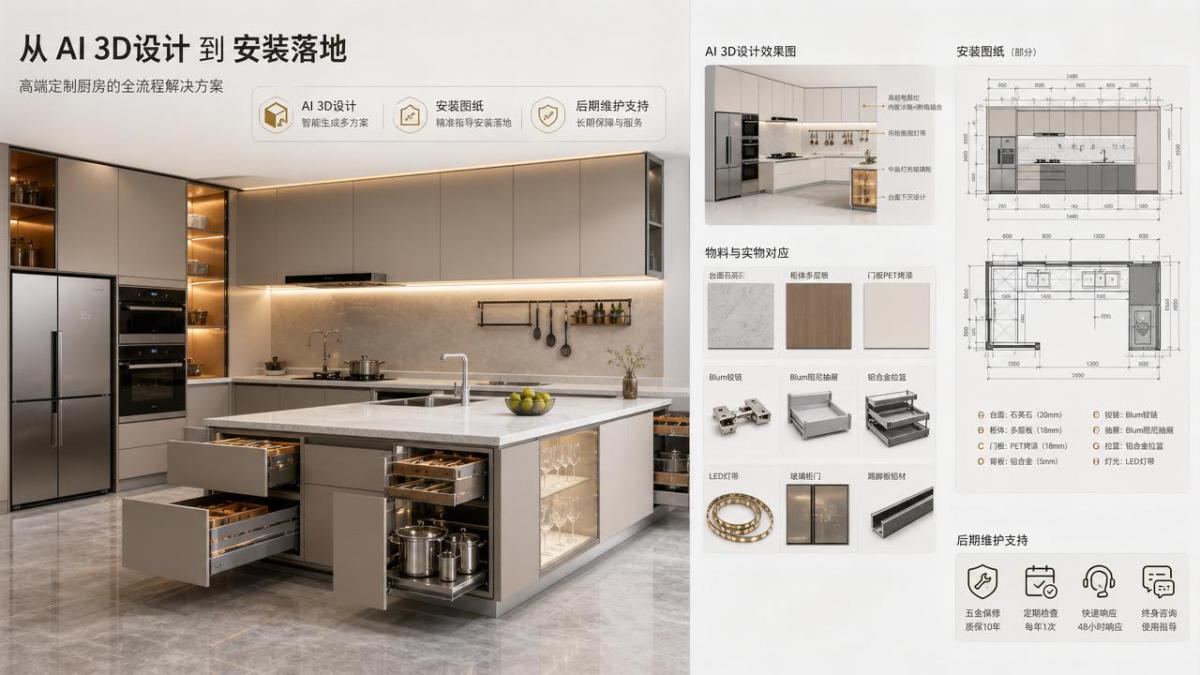
The company uses AI-powered 3D design tools that allow clients to visualize custom projects online, with design completion within 7 days in many cases. For maintenance teams, the main value of 3D-assisted design is clarity. A visual layout reduces ambiguity around corner solutions, pantry depth, door swing, overhead cabinet height, and the relationship between base units and tall units. This can be especially useful when overseas teams need remote support and cannot rely on the original installer being available.
KUCU also manufactures using CARB P2 and FSC-certified formaldehyde-free boards, supporting environmental compliance in North America and Australia. While that may seem more relevant to procurement, it also matters in after-sales practice. Certified boards and quality-controlled production can improve consistency in replacement parts, material matching, and long-term service expectations. When a maintenance team orders a replacement panel or door front, consistency in substrate and finish is a real advantage.
What installation drawings usually contain for service teams
To answer “Can KUCU provide kitchen cabinets design services?” from a maintenance perspective, it helps to define what installation drawings should include. In a professional cabinetry project, the useful drawing package typically covers plan views, wall elevations, cabinet coding, dimensions, appliance openings, service gaps, fillers, countertop transitions, and notes for special hardware or patented systems.
For after-sales teams, these drawings support several practical needs. First, they help locate the affected unit quickly. Second, they confirm the intended installation relationship between cabinets and surrounding building elements. Third, they reduce the risk of removing the wrong part during repairs. Fourth, they make it easier to communicate with the factory when requesting new components or technical confirmation.
This becomes even more important with custom features such as bi-fold doors, concealed hardware, and trackless sliding systems. KUCU highlights patented innovations that save space in compact apartments and condos. These systems can be excellent for usability, but they also require precise understanding during maintenance. Service personnel need to know opening behavior, concealed fitting locations, adjustment points, and safe disassembly methods. A cabinet design service without installation-level documentation would leave too many gaps.
Typical drawing elements that support maintenance
Useful documents may include cabinet numbering, room-by-room layout plans, internal structure notes, hinge-side indication, drawer bank configuration, toe kick detail, wall fixing notes, and hardware references. If the project involves islands, range hoods, or integrated refrigerators, the drawings should also show ventilation allowances, access panels, and critical alignment points. For large developments, unit-by-unit consistency charts are also helpful because after-sales teams often service multiple apartments with similar layouts but different finish options.
Where this service creates value in real projects
The value of KUCU’s kitchen cabinet design service is not limited to one type of client. It supports different maintenance realities across residential, multi-unit, and contractor-managed environments. In single-family homes, the main benefit is easier part replacement and cleaner communication after years of use. In apartments and condos, space-saving systems and compact layouts make accurate documentation even more critical. In contractor projects, standardized drawings support warranty management, technician training, and spare part planning.
Because KUCU serves both overseas households and construction contractors, its design support has practical relevance across these scenarios. The combination of custom manufacturing and project coordination helps maintenance teams avoid starting from zero whenever an issue appears on site.
Practical considerations for after-sales maintenance personnel
If your role involves servicing installed cabinetry, the right question is not only “Can KUCU provide kitchen cabinets design services?” but also “What design outputs should be retained for future maintenance?” In practice, after-sales teams should request and archive final approved drawings, cabinet lists, finish confirmations, hardware specifications, and any revision notes issued before production. These records reduce delays years later when project staff may have changed.
It is also wise to check whether the drawing set reflects the as-built condition or only the pre-production design intent. In real projects, installers sometimes make field adaptations. If those changes are documented, maintenance work becomes more accurate. If they are not, technicians should compare the original installation drawings with current site conditions before ordering parts or recommending major adjustments.
Another practical point is logistics. KUCU states average delivery times of 25 to 35 days with customs clearance, tracking, and local installation services. For maintenance teams, this matters when planning replacement schedules. If a cabinet front, side panel, or specialized mechanism must be remanufactured, documented design data helps reduce ordering errors and improve lead-time predictability.
Why KUCU is positioned well for export maintenance support
Several factors strengthen KUCU’s position in this area. First, 15 years of industry experience and service to 5,000+ overseas households and 200+ contractors suggest that the company understands the documentation demands of export cabinetry. Second, certifications such as CARB Phase 2, FSC, and ISO 9001 indicate a quality-focused operating framework, which supports consistency in both production and project communication. Third, the company’s focus on end-to-end service means design is not separated from manufacturing reality.
For maintenance personnel, that integration is often more valuable than generic design assistance. A visually attractive concept is useful, but a serviceable cabinet system requires manufacturing accuracy, labeled components, understandable drawings, and responsive follow-up. KUCU’s export orientation toward North America and Australia also means its teams are familiar with the expectations of overseas clients who depend on reliable remote coordination.
A clear answer and a practical next step
So, can KUCU provide kitchen cabinets design services? Yes, and the real value lies in combining custom cabinet design with installation drawings that remain useful after the kitchen is installed. For after-sales maintenance teams, this improves fault tracing, replacement accuracy, service speed, and communication with the manufacturer. In a sector where small dimensional errors can create major site problems, documentation is part of product quality.
If you are responsible for maintaining kitchen cabinet systems in homes, apartments, or contractor projects, it is worth confirming the full design package early: layout plans, elevations, hardware details, and installation notes. KUCU’s model of design, production, logistics, and installation support can make long-term cabinet maintenance more manageable and more predictable.
For project consultation or technical coordination, after-sales teams can contact Foshan KUCU Building Materials Co., Ltd. at sasa@fsgzhome.com or call +86 158 1717 8181. With export experience, certified materials, AI-assisted 3D design, and practical installation documentation, KUCU can support not just the sale of custom kitchen cabinets, but the long-term serviceability that keeps those systems performing well.