Custom Kitchen Cabinets & Whole House Cabinetry Manufacturer in China
KUCU is a China-based manufacturer providing custom kitchen cabinets, wardrobes and whole-house cabinetry for global residential and commercial projects.About KUCU.
What are the customization options for KUCU kitchen cabinets?? For finance approvers balancing project quality and budget control, KUCU offers flexible choices in materials, finishes, layouts, hardware, and storage features to match cost targets without sacrificing compliance or durability. With eco-certified boards, fast 3D design, and export-ready service, KUCU helps buyers compare value clearly and make cost-efficient cabinetry decisions with confidence.
Why budget control looks different across cabinet project scenarios
When finance teams ask, “What are the customization options for KUCU kitchen cabinets?”, they are usually not asking only about colors or door styles. They are trying to understand which options can be adjusted without weakening compliance, project speed, product life, or buyer satisfaction. A developer furnishing compact condos has different priorities from a remodeling contractor handling mid-range family homes. Likewise, a designer serving premium urban clients may accept higher spend on finishes if it improves marketability and perceived value.
That is why cabinet customization should be reviewed by application scenario. In practical procurement, cost is influenced by several connected choices: board grade, cabinet construction, door finish, internal accessories, hardware level, layout complexity, logistics requirements, and installation coordination. KUCU’s advantage is that these variables can be combined into a fit-for-purpose package rather than a one-size-fits-all quote.
For finance approvers in North America and Australia, the best decision is rarely the cheapest starting price. It is the option set that controls total project cost, reduces rework risk, meets environmental standards such as CARB P2 and FSC expectations, and supports on-time delivery. This is where KUCU’s custom whole-home manufacturing model becomes useful: the buyer can scale up or scale back specific features based on project type.
What are the customization options for KUCU kitchen cabinets in cost-sensitive applications?
To evaluate cabinet cost logically, it helps to group the customization options into controllable categories. KUCU allows buyers to customize the following core items, each with a different budget impact:
- Board materials: CARB P2 and FSC-certified boards, formaldehyde-free panels, and different substrate selections for target price ranges.
- Door styles: slab doors, shaker doors, glass-front inserts, bi-fold options, and other design variations.
- Surface finishes: laminate, melamine, PVC, painted, matte, gloss, wood-grain, and textured surfaces.
- Layout configurations: straight, L-shaped, U-shaped, island kitchens, galley kitchens, and compact apartment layouts.
- Hardware levels: standard hinges and runners, soft-close systems, concealed hardware, and upgraded premium mechanisms.
- Storage features: pull-out trays, corner systems, drawer organizers, pantry units, trash pull-outs, and appliance housing.
- Space-saving solutions: KUCU’s patented bi-fold doors, trackless sliding systems, and hallway-friendly concealed details.
- Service scope: design-only, production, export packaging, shipping, customs support, and local installation coordination.
The key for finance review is not selecting the maximum number of upgrades. It is matching these options to actual end-user needs and expected operating conditions.
Scenario comparison: where different cabinet options make financial sense
Below is a practical comparison to help answer what are the customization options for KUCU kitchen cabinets under different business scenarios.
For many buyers, this comparison reveals that budget control is not simply about reducing materials. It is about selecting the right level of customization for the right environment.
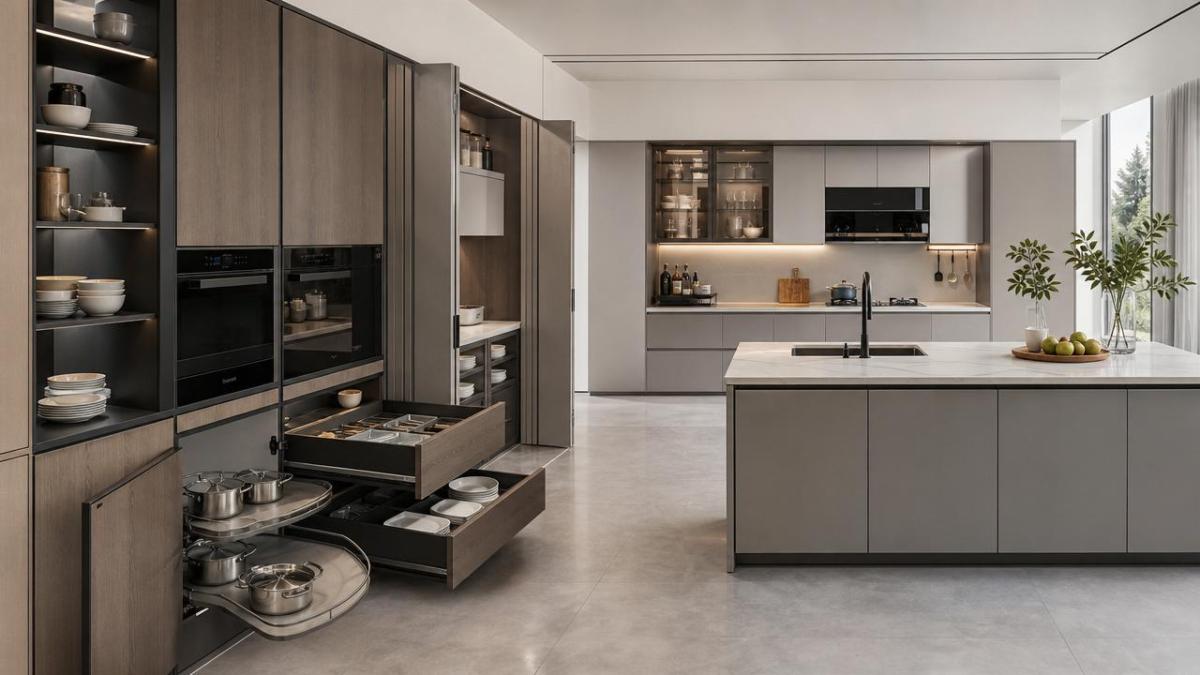
Typical use cases and the best-fit KUCU cabinet options
1. Multi-unit residential projects that need cost predictability
In high-volume developments, the biggest risk is variation. Too many unique cabinet dimensions, finish changes, or hardware tiers can increase manufacturing complexity, delay installation, and create replacement issues. In this scenario, the best answer to what are the customization options for KUCU kitchen cabinets is selective standardization. Buyers can standardize cabinet boxes and common modules while allowing limited visual variation in door colors or handles.
A finance approver should prioritize durable board options, straightforward finishes, and easy-to-install hardware packages. KUCU’s 25–35 day export delivery capability and end-to-end coordination also matter here because logistics delays often cost more than moderate product upgrades.
2. Homeowner remodeling projects where value perception matters
For kitchen remodels, visual return is often as important as material return. Homeowners may not need every internal organizer, but they do care about finish quality, storage convenience, and how the kitchen photographs for resale or rental listings. In this case, KUCU’s AI-powered 3D design becomes a budget tool, not just a design feature. It lets decision-makers compare lower-cost and upgraded versions before production begins.
A good strategy is to spend on highly visible elements such as door finish and drawer smoothness, while keeping less visible areas simpler. This creates a better cost-to-perception ratio.
3. Compact apartments and condos where space efficiency affects livability
This is one of KUCU’s strongest application areas. In small kitchens, the wrong door swing, poor corner planning, or oversized cabinetry can reduce functional walking space. KUCU’s patented bi-fold doors and trackless sliding systems are especially relevant because they can save hallway and circulation space while improving access.
For finance teams, these features should be evaluated as efficiency enhancers rather than luxury upgrades. In tight-floorplan projects, better access and reduced obstruction can improve tenant experience and reduce complaints, making them worthwhile in specific units.
4. Premium homes and designer-led projects that need customization depth
In upscale projects, buyers often ask what are the customization options for KUCU kitchen cabinets because they want more than standard modular supply. Here, custom dimensions, integrated appliance storage, specialty finishes, and concealed hardware can support a more seamless interior concept. The financial review should focus on whether these upgrades are linked to customer expectation, selling price, or brand positioning.
If premium detailing improves final property value or client conversion, the added cost is easier to justify. If it does not, selective upgrades are usually the better route.
How different customization categories affect budget decisions
Material selection
Materials affect compliance, durability, and price stability. KUCU’s CARB P2 and FSC-certified formaldehyde-free boards are especially valuable for export markets like the USA, Canada, and Australia, where environmental performance matters. For finance approvers, certified materials reduce compliance risk and support smoother project acceptance.
Finish choice
Some finishes are primarily visual; others also affect maintenance and wear resistance. Melamine and laminate often work well for cost-sensitive or rental-oriented projects. Painted finishes may suit premium homes where appearance drives value. The right question is not “Which finish is best?” but “Which finish is best for this occupancy and budget model?”
Hardware and internal functions
Soft-close hardware, pull-outs, corner systems, and concealed fittings can improve user experience, but not every project needs the same package. A smart approval model is to define must-have, nice-to-have, and market-specific upgrades. KUCU can configure hardware by scenario so buyers avoid overspecifying low-priority units.
Design and layout complexity
Custom shapes, unusual dimensions, and highly fragmented layouts often raise production and installation costs. However, they may also solve difficult floorplans. KUCU’s 3D design process, typically completed within 7 days, helps procurement teams compare complexity against benefit before locking the order.
Common misjudgments finance approvers should avoid
- Approving by unit price only and ignoring freight, customs, replacement risk, and installation time.
- Removing all upgraded storage features even when compact kitchens require better functionality.
- Assuming certified eco-materials are optional, despite target market compliance expectations.
- Over-customizing every unit instead of segmenting standard, upgraded, and premium packages.
- Failing to use design visualization early, which can lead to revisions after production approval.
These mistakes often create hidden costs that exceed the savings from a lower initial quotation.
Practical approval framework for choosing KUCU cabinet customization
If your team is evaluating what are the customization options for KUCU kitchen cabinets, use a simple approval sequence:
- Define the project scenario: development, remodel, premium home, or compact urban unit.
- Separate mandatory requirements from optional enhancements.
- Confirm environmental and export compliance needs for destination markets.
- Review 3D design alternatives to compare space use and finish impact.
- Calculate total landed and installed cost, not factory price alone.
- Approve a tiered specification package where appropriate.
This method helps finance approvers align procurement decisions with operational reality and sales objectives.
FAQ: what buyers usually ask before approval
Are KUCU kitchen cabinets suitable for both cost control and custom design?
Yes. KUCU’s model is useful because customization can be scaled. Buyers can keep the core cabinet system economical while selectively upgrading finishes, storage, or hardware where it creates measurable value.
What are the customization options for KUCU kitchen cabinets that most affect price?
The main cost drivers are board type, finish process, hardware grade, cabinet size variation, internal accessories, and service scope including shipping and installation coordination.
Which projects benefit most from KUCU’s patented space-saving systems?
Compact apartments, condos, and narrow circulation kitchens benefit the most. In these settings, bi-fold doors and trackless sliding systems can add practical usability that justifies the added specification.
Why do certified materials matter to finance teams?
Because non-compliance can create rejection risk, delay occupancy, increase replacement cost, and damage buyer confidence. Certified eco-boards support smoother approval and long-term brand trust.
Final decision guidance for scenario-based cabinet approval
The best answer to what are the customization options for KUCU kitchen cabinets depends on where the cabinets will be used, who the end user is, and what financial result the project needs to achieve. For finance approvers, the smartest approach is to compare options by scenario instead of by catalog alone. Standardized modules may be ideal for volume housing, upgraded finishes may make sense in remodeling, and patented space-saving features may deliver real value in compact apartments.
Foshan KUCU Building Materials Co., Ltd. supports this decision process with eco-certified materials, AI-based 3D design, patented functional solutions, and export-focused service for North America and Australia. If you are reviewing a kitchen cabinet budget and need a scenario-matched proposal, contact KUCU at sasa@fsgzhome.com or +86 158 1717 8181 to compare configuration options, lead times, and total project value with greater clarity.