

Choosing the best materials is the key to a successful open cabinet custom design, especially for buyers, project managers, and distributors who need durability, style, and cost control. From wood-based panels to metal and glass combinations, the right material can improve both function and visual appeal while meeting different project requirements in residential and commercial spaces.
In the building decoration materials industry, open cabinet systems are no longer limited to display shelving or light residential use. They are now widely specified for kitchens, wardrobes, bathroom vanities, retail interiors, serviced apartments, and mixed-use projects. For B2B buyers, the material decision directly affects service life, installation efficiency, transportation safety, and after-sales claims.
For project leaders and channel partners, material selection also influences budget control across the full supply chain. A cabinet that looks attractive in a sample room may underperform when exposed to humidity levels above 65%, repeated loading cycles, or fast-track installation schedules of 15 to 30 days. That is why open cabinet custom design should begin with a practical material framework rather than appearance alone.
Kucu Building Materials Co., Ltd., based in Foshan, Guangdong, operates a 40,000 square meter manufacturing center with 8 production lines and 20 years of customized cabinet experience. For builders, design firms, decoration contractors, and building owners, this kind of integrated production, design, and export capability matters because open cabinet projects often require coordinated finishes, repeatable dimensions, and stable lead times.
Material Priorities in Open Cabinet Custom Design
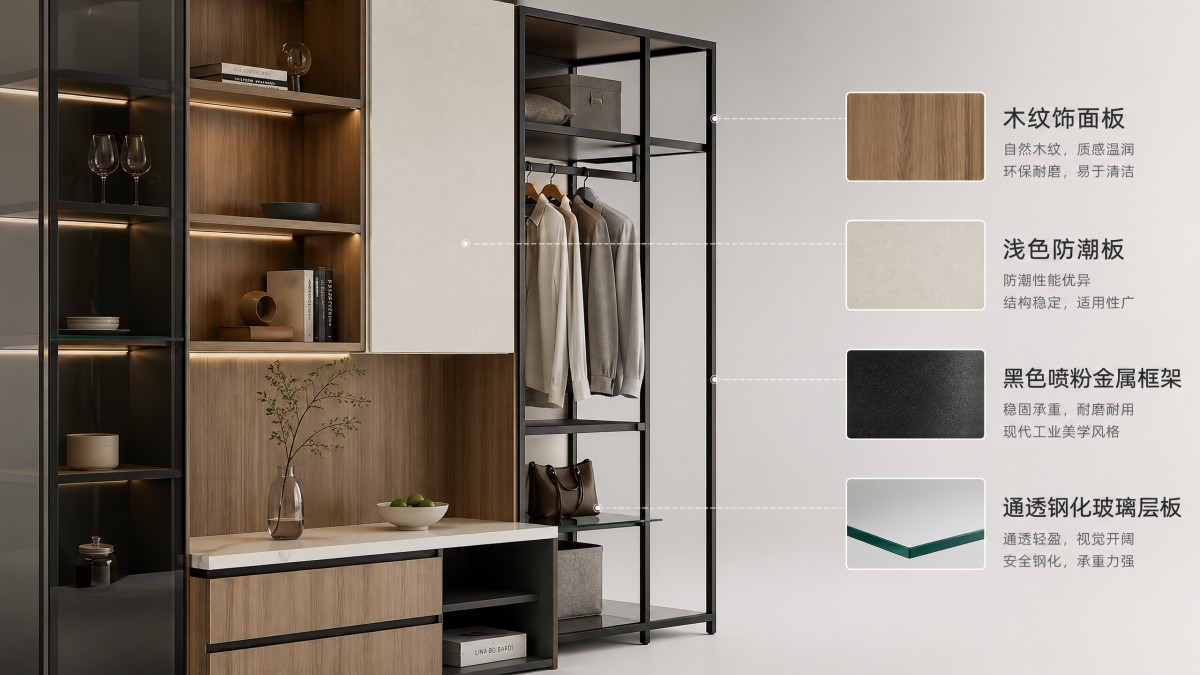
Open cabinet custom design differs from closed cabinet systems because more surfaces remain visible and more edges are exposed. This means the selected material must perform in 3 visible dimensions at the same time: structure, finish consistency, and edge quality. In many commercial or multi-unit residential projects, even a 1 to 2 mm inconsistency in panel alignment can be noticeable in open shelving layouts.
Buyers usually evaluate materials through 4 major factors: cost per square meter, resistance to moisture and wear, ease of fabrication, and visual compatibility with the interior concept. Project managers often add 2 more concerns: installation tolerance and replacement convenience. Distributors also care about whether the material can be stocked in standard colors and thicknesses such as 16 mm, 18 mm, and 25 mm.
Another key point is application environment. Open cabinets in kitchens face grease, heat, and daily cleaning. Bathroom vanity shelving deals with splashing water and higher humidity. Wardrobe display sections require stable load-bearing performance and good color matching under artificial lighting. One material rarely suits all 3 spaces equally, so specification should remain use-based.
For high-volume developments, the best materials are not always the most expensive ones. The better approach is to match performance grade to project type. A rental apartment project may prioritize wear resistance and fast production, while a high-end showroom may prioritize texture, lower visible seams, and mixed-material detailing using glass or metal.
What procurement teams should assess first
- Base material stability under seasonal humidity fluctuation of roughly 40% to 75%.
- Surface finish durability against scratches, cleaning chemicals, and frequent handling.
- Edge banding quality, especially on visible shelves and open side panels.
- Compatibility with hardware, concealed supports, and wall anchoring methods.
- Repeat production accuracy for multi-unit orders and export packing safety.
Why open structures increase material demands
A closed cabinet can hide minor finish differences behind doors, but an open cabinet cannot. Exposed layers, corner joints, and horizontal spans need better control. Shelves longer than 800 to 1000 mm, for example, may require thicker boards, hidden reinforcement, or metal framing to avoid deflection under books, tableware, or retail display products.
This is especially important for project delivery teams. If the design intent includes floating shelves, matte surfaces, or dark colors, every machining step matters more. Dark matte laminates often show dust and scratches faster than medium-tone woodgrain finishes, while glossy surfaces may reveal substrate waviness if production quality is inconsistent.
Best Core Materials: Wood-Based Panels, Plywood, Metal, and Glass
Most open cabinet custom design projects begin with wood-based panels because they offer a practical balance of cost, machinability, and finish flexibility. Common options include MDF, particle board, and plywood. Each has a different role in cabinet manufacturing, and selection should depend on load requirements, moisture exposure, and finish type rather than habit alone.
MDF is widely used where a smooth painted or laminated surface is required. It machines cleanly and works well for modern open shelving with routed details. However, standard MDF is less suitable for wet zones unless a moisture-resistant grade is specified. In bathrooms or utility areas, a better choice is moisture-resistant board or plywood with proper edge sealing.
Particle board remains common in cost-sensitive projects because it supports efficient mass production and stable panel dimensions. When combined with quality melamine surfaces and reliable edge banding, it can be a strong option for wardrobes and dry-zone kitchen storage. For longer spans or premium installations, plywood often performs better because it offers stronger screw holding and improved structural reliability.
Metal and glass are often used as secondary materials rather than full replacements. Powder-coated steel or aluminum frames can increase rigidity in open cabinets, especially for minimalist or industrial designs. Glass shelves or side panels improve visual lightness, but they must be specified with safety thickness and secure fixing details, especially in public or hospitality environments.
Typical material comparison for project use
The table below compares common cabinet materials from a project procurement perspective. It focuses on typical building decoration material considerations, including moisture suitability, fabrication behavior, and recommended applications.
For many B2B projects, plywood or moisture-resistant panel systems provide the safest middle ground when open cabinet design includes wet-zone exposure or heavy daily use. MDF remains strong for design-driven projects, while particle board can work well when paired with realistic load planning and standard shelf spans.
When glass should be added
Glass is most effective when used selectively, such as shelf inserts, side accents, or display sections. In practice, 6 mm to 10 mm tempered glass is common for open shelving depending on span and support method. It adds premium appearance and light transmission, but it should not be treated as a cost-neutral decoration because packaging, breakage control, and installation precision all increase.
Surface Finishes, Edge Details, and Visual Performance
The base board is only one part of successful open cabinet custom design. Surface finish determines how the cabinet performs in daily cleaning, color retention, and scratch visibility. In open storage, users touch, see, and clean exposed surfaces more frequently than door fronts. This makes finish quality a commercial issue, not just a design issue.
Melamine-faced panels are a practical option for many large-scale projects because they combine stable production, color consistency, and efficient maintenance. They are often used in 16 mm or 18 mm board formats and can provide convincing woodgrain, textile, or solid-color looks. For budget control and multi-unit developments, this is often one of the most efficient finish systems.
Lacquered and painted finishes offer greater design freedom, especially for bespoke wardrobes and bathroom vanity shelving where exact color matching matters. However, painted surfaces usually demand tighter substrate preparation and handling control during packing and site installation. In high-traffic use, touch-up complexity should be considered before approval.
Edge treatment is equally important. In open cabinets, poorly bonded edge banding or mismatched edge color becomes visible immediately. Standard PVC or ABS edge banding in 1 mm to 2 mm thickness is common, while thicker edging may be preferred on exposed shelf fronts where impact risk is higher. For moisture-prone environments, sealed edges are not optional.
Finish selection by project priority
The following table helps procurement and design teams choose finishes based on maintenance expectations, visual style, and project positioning.
For distributors and developers, the key conclusion is simple: the best surface for open cabinets is the one that balances appearance with maintenance frequency. In many projects, a realistic woodgrain melamine with good edge quality will outperform a delicate painted finish over a 3 to 5 year operating cycle.
Common finish mistakes to avoid
- Using standard board in wet areas without sealed cut edges or splash-zone planning.
- Selecting high-gloss finishes for heavy-use family kitchens where fingerprints become a daily issue.
- Ignoring shelf front impact risk on open wardrobe units used by tenants or hotel guests.
- Approving samples under one lighting condition only, then facing color shift complaints on site.
How to Match Materials to Kitchens, Wardrobes, and Bathroom Vanity Projects
A strong open cabinet custom design strategy always connects material choice to the use environment. Kitchens, wardrobes, and bathroom vanity systems operate under different stress conditions. Procurement teams can reduce rework and maintenance issues by specifying materials according to exposure level, load, and cleaning routine instead of copying one standard schedule across all rooms.
In kitchens, open cabinets should resist steam, oil, and regular wiping. Shelves near cooking zones need finishes that do not trap grease easily. Moisture-resistant board, plywood, or high-quality melamine-faced panels are often practical. If the span exceeds 900 mm and the shelf will hold ceramic ware or small appliances, reinforcement should be considered in the early design phase.
For wardrobes, visual coordination is often the top concern, but load still matters. Open sections for folded clothing, bags, and accessories usually work well with 16 mm to 18 mm boards. However, if the design includes integrated lighting, glass accents, or suspended shelves, cable routing and frame fixing details should be confirmed before production drawings are frozen.
Bathroom vanity applications require the most caution. Even if the cabinet is partially open, repeated exposure to water splash and humid airflow can shorten service life if the wrong substrate is used. Moisture-resistant board with sealed edges, plywood, and corrosion-resistant metal supports are usually safer than standard interior-grade materials.
Application-based material guide
This project-oriented matrix can help buyers and project managers choose a practical combination for different cabinet categories.
For companies handling mixed projects, standardizing 2 or 3 approved material combinations often improves purchasing efficiency. It reduces sample approvals, shortens communication cycles, and helps maintain consistency across kitchens, wardrobes, and vanity packages within the same development.
A practical 5-step selection process
- Define the room type and exposure level: dry, moderate humidity, or wet-adjacent use.
- Confirm expected loading, including shelf span, supported weight, and wall fixing method.
- Choose the surface finish based on cleaning frequency and visual positioning.
- Review edge detail, hardware interface, and packing requirements for transport.
- Approve a sample that reflects final color, edge, and substrate combination rather than finish alone.
Procurement, Manufacturing, and Delivery Considerations for B2B Buyers
Even the best materials can create project problems if procurement planning is weak. In custom cabinet supply, success depends on how well material choice aligns with production capability, shop drawing accuracy, and export packaging. For large orders, buyers should not only ask what material is used, but also how consistently it can be processed across multiple batches.
A manufacturer with integrated design, production, and export coordination can reduce communication gaps. This is relevant when the project includes repeated unit types, phased shipments, or different cabinet categories such as kitchen cabinets, wardrobes, and bathroom vanity products. Coordination becomes even more important if the lead time target is within 20 to 45 days depending on quantity and finish complexity.
For project managers, dimensional accuracy and packaging logic are often as important as material grade. Panels should be labeled clearly, hardware packed by zone, and fragile finish items separated. Open cabinet parts have more exposed edges, so poor packing can cause visible damage before installation begins. This is a common hidden cost in international shipment and site handling.
Distributors and agents should also consider reorder stability. If a material or finish cannot maintain color continuity over the next 6 to 12 months, small replenishment orders may become difficult. It is better to work with suppliers that can support repeat production with controlled sourcing and stable machining standards.
Checklist for supplier evaluation
- Can the supplier handle multiple cabinet categories under one project package?
- Are standard board thicknesses, finish samples, and edge options available for approval?
- What is the normal production cycle for sample orders, pilot units, and mass production?
- How are export packing, labeling, and installation sequence managed?
- Can shop drawing revision and technical communication be completed efficiently?
Why integrated capability matters
Kucu’s 40,000 square meter manufacturing center and 8 production lines suggest a structure suited to customized cabinet programs that need both flexibility and throughput. For B2B customers, this type of setup can support variation in cabinet configuration while maintaining production discipline. It is especially relevant for builders, design companies, decoration companies, and building owners managing schedule risk across several spaces at once.
A supplier with 20 years of customized cabinet experience is also more likely to understand the gap between showroom samples and project execution. Material recommendations should therefore be tied to real installation conditions, site tolerance, and shipping protection instead of only visual presentation in a catalog.
Common Questions and Final Recommendations
Open cabinet custom design delivers strong visual impact and flexible storage, but material performance determines whether the result stays attractive after months or years of use. For most B2B buyers, the best approach is not to search for one universal material, but to create a clear selection logic based on room type, budget band, finish expectation, and project timeline.
In practical terms, moisture-resistant panels and plywood suit more demanding conditions, melamine-faced boards offer strong value for repeated projects, and metal or glass additions work best when they solve a structural or aesthetic need. Edge quality, span control, and packaging protection should always be treated as part of the material decision.
For buyers, project managers, and distributors, a reliable supplier should help translate design intent into production-ready specifications. That includes material matching, finish coordination, sample review, and realistic delivery planning. These details reduce variation, lower claim risk, and make installation more predictable across residential and commercial spaces.
If you are sourcing open cabinet solutions for kitchen cabinets, wardrobes, or bathroom vanity projects, Kucu can support customized production with design, manufacturing, and export coordination. Contact us to discuss your material options, request a tailored cabinet solution, or get more details for your next project.
How do I choose the best material for an open kitchen cabinet?
Start with moisture and cleaning exposure. For kitchens, moisture-resistant board or plywood is often safer than standard interior board, especially near sinks or cooktops. If shelves are longer than about 900 mm or expected to carry heavy dishware, increase thickness or add metal reinforcement.
Which material is most cost-effective for multi-unit residential projects?
Melamine-faced particle board or MDF is often the most cost-effective for dry-zone wardrobes and standard storage, provided edge banding and load expectations are controlled well. It supports repeatable production, simpler maintenance, and easier color standardization across large unit counts.
Are metal and glass suitable for open cabinet custom design?
Yes, especially when a project needs slimmer profiles, premium display appeal, or reinforced shelf structures. However, they usually increase fabrication precision requirements, packaging care, and installation coordination. They work best as part of a hybrid material solution instead of a default choice for every cabinet.
What should distributors and project managers check before ordering?
Review 6 key points: substrate type, finish specification, edge banding thickness, shelf span, packing method, and lead time. Also confirm whether samples reflect the final board and edge combination, not just the surface color, because open cabinets expose every detail after installation.