Custom Kitchen Cabinets & Whole House Cabinetry Manufacturer in China
KUCU is a China-based manufacturer providing custom kitchen cabinets, wardrobes and whole-house cabinetry for global residential and commercial projects.About KUCU.
Can KUCU provide kitchen cabinets design services?? Yes—and that support begins well before production. For procurement professionals seeking reliable custom cabinetry partners, KUCU offers AI-powered 3D kitchen cabinet design, fast turnaround within 7 days, and export-ready solutions tailored to North America and Australia. From layout planning to material selection, KUCU helps reduce project risk, improve decision-making, and ensure every cabinet order matches quality, compliance, and installation requirements.
For buyers in the building and decorative materials sector, early-stage cabinet design is not just a visual exercise. It directly affects quoting accuracy, installation compatibility, project scheduling, shipping efficiency, and after-sales risk. When a supplier can provide kitchen cabinet design services before production starts, procurement teams gain a clearer basis for comparing options, controlling budgets, and preventing costly changes after manufacturing begins.
Foshan KUCU Building Materials Co., Ltd. positions this pre-production support as a core part of its export cabinetry service. With 15 years of industry experience, service coverage across North America and Australia, and a 7-day design turnaround, KUCU helps importers, contractors, developers, and sourcing managers move from concept to production with better visibility and fewer execution gaps.
Why Pre-Production Kitchen Cabinet Design Matters in Procurement
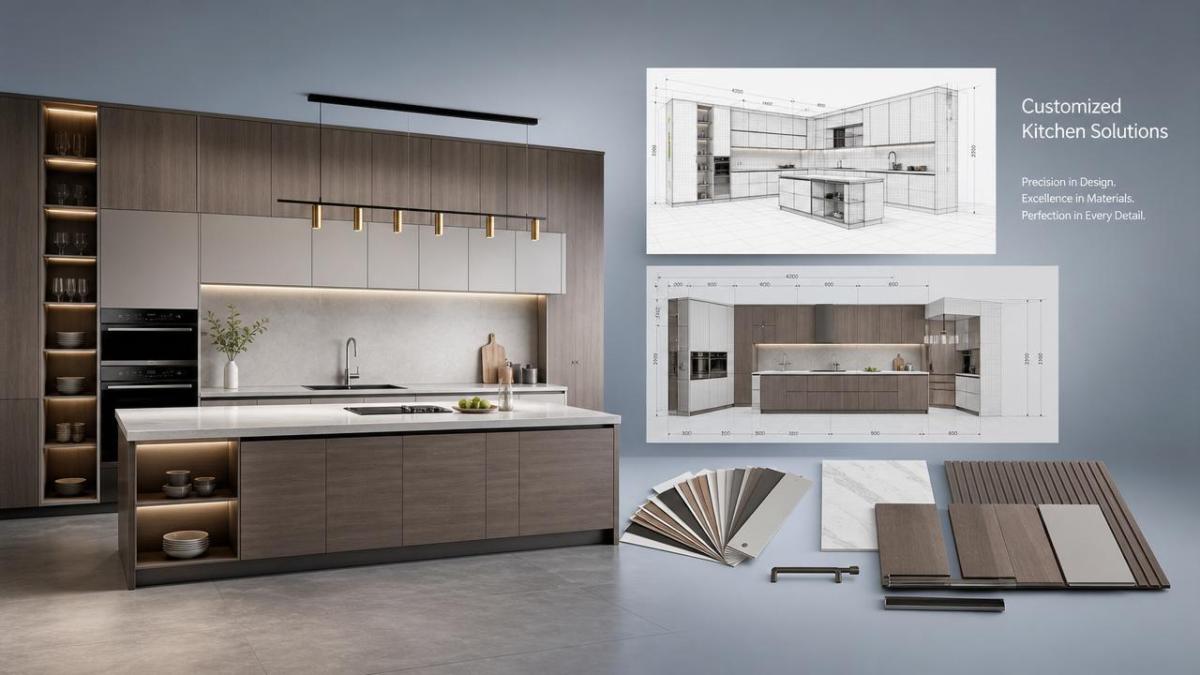
In custom cabinetry procurement, the design phase often determines whether a project stays on schedule or enters a cycle of revisions, material waste, and field adjustments. A cabinet supplier that only starts discussing structure after the order is confirmed creates avoidable risk. By contrast, KUCU provides kitchen cabinets design services before production so buyers can verify layout logic, storage capacity, finish alignment, and technical feasibility in advance.
Design support reduces four common sourcing risks
For procurement teams, four issues frequently affect imported kitchen cabinet projects: inaccurate dimensions, mismatch between design intent and production details, code or material compliance concerns, and installation conflicts at the destination site. Addressing these points during a 3D design stage is often more efficient than correcting them after panel cutting, drilling, edging, and packing have already begun.
- Dimension validation before production drawings are locked
- Hardware and opening method review for compact or high-traffic kitchens
- Material selection aligned with CARB P2 and FSC requirements
- Packing, shipping, and installation planning for export projects
How KUCU supports earlier decision-making
KUCU uses AI-powered real-time 3D design tools, allowing clients to visualize cabinet layout, door style, color combination, and space use before manufacturing starts. This is particularly valuable for multi-unit developments, renovation contractors, and sourcing companies handling 2 to 5 stakeholders per project, where design approval often involves the buyer, designer, installer, and end client.
The practical value is speed with clarity. KUCU can complete custom design proposals within 7 days, which helps buyers shorten their internal review cycle and move faster into sample confirmation, quotation alignment, and production scheduling. In export business, saving even 5 to 7 days in pre-production can support better container planning and reduce pressure on downstream site deadlines.
Typical design inputs buyers should prepare
To get the most accurate cabinet design service, procurement professionals should provide a basic project package at the beginning. This usually includes room dimensions, appliance specifications, preferred finishes, estimated order quantity, and delivery location. If these 5 items are ready early, the supplier can produce a more precise and buildable design proposal with fewer revision rounds.
The table below shows how early design support improves purchasing control compared with a production-first sourcing approach.
The key takeaway is simple: pre-production design is not an optional extra for custom kitchen cabinets. It is a control point that improves purchasing visibility, especially when projects involve export logistics, local compliance, and custom sizing. This is one reason many professional buyers ask first, “Can KUCU provide kitchen cabinets design services?” before discussing unit price alone.
What KUCU’s Kitchen Cabinet Design Service Includes Before Production
KUCU’s pre-production service is structured to help buyers move from concept review to factory-ready confirmation in a practical sequence. Rather than limiting support to a basic sketch, the company integrates design, material planning, export requirements, and installation considerations into one workflow. For B2B buyers, this means fewer handoff gaps between sales communication and manufacturing execution.
1. Layout planning and space optimization
Kitchen layouts are assessed based on room size, traffic flow, appliance placement, and storage needs. Standard planning may involve L-shape, U-shape, galley, island, or one-wall configurations, but KUCU’s design team adapts these to the actual site and user scenario. In apartments and condos where every 100 to 200 mm matters, small layout changes can improve movement and usable storage significantly.
Compact-space solutions for urban housing
For projects in California, Toronto, Sydney, or Melbourne, compact floor plans are common. KUCU’s patented features, such as Bi-Fold Doors, trackless sliding systems, and concealed hardware, are useful where swing clearance is limited. In selected hallway-adjacent or narrow-access areas, these solutions can save up to 90% of passage space compared with conventional door movement requirements.
2. Material and finish selection aligned with target markets
Material specification is a critical part of any kitchen cabinet design service because visual design without compliance planning creates downstream risk. KUCU uses CARB P2 and FSC-certified formaldehyde-free boards, which helps buyers sourcing for the USA, Canada, and Australia address common environmental and material compliance expectations from the start.
During design review, buyers can compare board types, finishes, door styles, and hardware combinations based on budget tier, moisture exposure, maintenance needs, and project image. This matters for procurement because the same layout can perform differently depending on whether the kitchen is intended for owner-occupied housing, rental projects, or contractor-led developments.
3. 3D visualization and revision control
KUCU’s real-time 3D tools allow clients to review proportions, elevation details, and finish combinations before production starts. For procurement staff, this supports internal approval and helps reduce ambiguity. It is easier to identify a filler panel issue, appliance mismatch, or inconvenient drawer layout in a visual model than in a 2D note-based quotation alone.
In many projects, 1 to 3 rounds of design adjustment are normal before approval. The advantage of an organized pre-production process is that revisions happen while costs are still controllable. Once production documents are frozen, each late change may affect machining, lead time, and packing sequence.
4. Export and installation coordination
A cabinet design is not truly complete if it ignores shipping and site assembly. KUCU links design decisions with production, customs clearance, shipment tracking, and local installation support. Average delivery time is 25 to 35 days, depending on destination and project complexity, which is an important planning benchmark for buyers handling phased construction or renovation schedules.
The table below outlines the practical components procurement teams can expect from KUCU before production begins.
For procurement professionals, the value of this service package lies in continuity. Design, compliance, production planning, and delivery are connected early, which reduces the risk that one team’s assumptions become another team’s problem later in the project.
How Buyers Should Evaluate a Cabinet Design Partner Before Ordering
Not all cabinet suppliers provide the same level of design support. Some can only quote based on simple dimensions, while others can translate project goals into buildable, export-ready solutions. When assessing whether KUCU can provide kitchen cabinets design services at the level your project requires, it is useful to review four evaluation areas: technical depth, compliance readiness, response speed, and service integration.
Technical depth and buildability
Ask whether the supplier’s design output includes cabinet module logic, appliance accommodation, opening clearance, filler sizing, and hardware coordination. A visually attractive layout is not enough if it cannot be manufactured efficiently or installed cleanly on site. Buyers should also verify whether special features like concealed hardware or sliding systems are considered at the design stage rather than added later.
Compliance and documentation awareness
For export buyers, the design conversation should include board standards, finish suitability, and documentation consistency. KUCU’s use of CARB Phase 2 and FSC-certified materials is relevant here because the design proposal can already be aligned with target market expectations. That saves time compared with redesigning after a compliance review flags a material mismatch.
Response speed and revision discipline
Speed matters, but speed without version control can create confusion. A professional partner should be able to issue design updates, track feedback, and confirm final approval before production release. KUCU’s 7-day design capability is useful for buyers managing tender deadlines, model home timelines, or contractor handover schedules where delay in one package can affect the next 2 or 3 trades.
End-to-end service relevance
A kitchen cabinet design service is more valuable when it is supported by production, logistics, and installation knowledge. KUCU’s export focus, local market coverage in major cities across the USA, Canada, and Australia, and average 25 to 35 day delivery network give buyers a more practical basis for planning than design-only studios without fulfillment capability.
- Confirm whether the supplier designs according to actual site dimensions.
- Review material certifications before finalizing finishes.
- Ask for 3D visualization and revision checkpoints.
- Check how design data transfers into production drawings and packing.
- Align lead time, shipping route, and installation requirements before deposit.
This 5-step evaluation method helps procurement teams compare suppliers on execution quality instead of unit price alone. In custom cabinetry, lower upfront pricing can become more expensive if design omissions lead to delays, replacement panels, or site rework.
Common Questions Procurement Teams Ask About KUCU’s Design Services
Can KUCU design for both residential and contractor projects?
Yes. KUCU serves overseas households as well as more than 200 construction contractors, so the design process can adapt to single-home customization, developer packages, and multi-unit procurement. The design depth may vary by project scope, but the goal remains the same: make sure the cabinets are functional, compliant, and ready for production.
How long does the design phase usually take?
KUCU states that design can be completed within 7 days. Actual timing depends on how complete the initial information is and how many revisions are needed. If room measurements, appliance sizes, finish preferences, and project quantity are submitted at the start, the process is usually more efficient.
Can buyers review materials before production?
Yes, material planning is part of the pre-production stage. Buyers can review board standards, finish direction, and hardware selection before manufacturing begins. This is especially important for projects requiring CARB P2 and FSC-aligned sourcing or those balancing cost with durability in high-use kitchens.
Why is early design especially important for export orders?
Once an export cabinet order is produced, packed, and shipped internationally, correcting errors becomes more time-consuming and more expensive than in local procurement. Early design verification lowers the risk of mismatch in dimensions, finish expectations, and installation sequence. For international buyers, that prevention value is often more important than a small difference in initial quotation.
For procurement professionals asking, “Can KUCU provide kitchen cabinets design services?” the answer is clearly yes, and the practical benefit lies in what happens before production starts. KUCU combines AI-powered 3D visualization, 7-day design turnaround, eco-certified materials, export-oriented manufacturing, and logistics coordination into one service path that supports better purchasing decisions.
If you are sourcing custom kitchen cabinets for North America or Australia and need a supplier that can help with design, compliance, production, and delivery, KUCU is positioned to support the full process. To discuss your layout, project quantity, material requirements, or delivery schedule, contact KUCU at sasa@fsgzhome.com or call +86 158 1717 8181 to get a tailored cabinet solution and detailed project guidance.