Custom Kitchen Cabinets & Whole House Cabinetry Manufacturer in China
KUCU is a China-based manufacturer providing custom kitchen cabinets, wardrobes and whole-house cabinetry for global residential and commercial projects.About KUCU.
What are the customization options for KUCU kitchen cabinets?? For technical evaluators, the key answer is not just style variety, but how customization performs under real project requirements. KUCU offers a broad configuration range across substrate materials, door constructions, surface finishes, colors, edge details, hardware systems, and storage functions, while maintaining compliance with CARB P2 and FSC standards for North America and Australia.
From an evaluation standpoint, the most important point is that KUCU’s customization model is engineered to balance three priorities at the same time: environmental compliance, manufacturing flexibility, and export execution. That means material choices are not treated as isolated catalog options. They are tied to durability expectations, finish behavior, project budgets, installation conditions, and shipping realities.
For buyers, developers, architects, and technical review teams comparing suppliers, the real question behind “What are the customization options for KUCU kitchen cabinets?” is usually this: how much can be customized without losing quality consistency, certification alignment, or delivery reliability? This article focuses on that practical question and explains where KUCU offers meaningful flexibility by material and finish.
What Technical Evaluators Usually Need to Confirm First
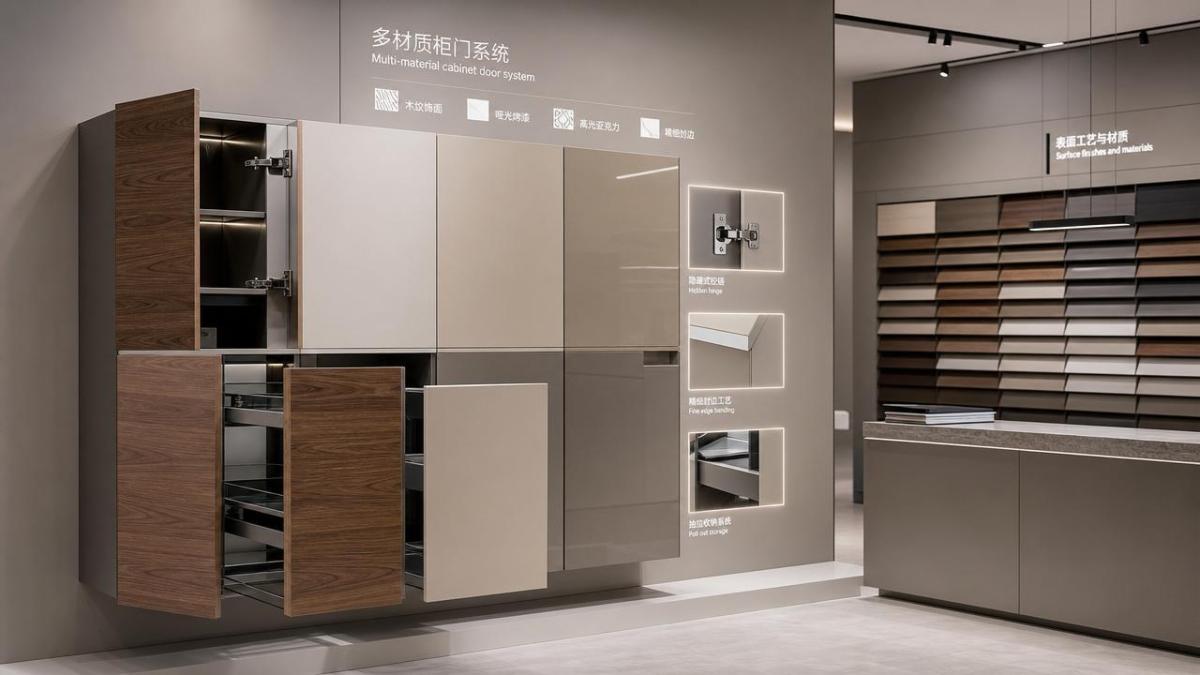
Before reviewing colors or door styles, technical evaluators usually want clarity on four issues: board compliance, finish durability, dimensional customization, and hardware compatibility. These factors determine whether the cabinet package can meet code-related expectations, withstand use conditions, and fit the intended market segment.
In export projects for the USA, Canada, and Australia, material documentation matters as much as visual appeal. KUCU’s use of CARB P2 and FSC-certified formaldehyde-free boards addresses a major prequalification requirement for environmentally responsible residential and multi-unit projects. For technical teams, this reduces uncertainty during supplier screening.
The next concern is whether finish options are only decorative or also performance-based. In kitchen applications, surfaces must resist moisture, grease, abrasion, and cleaning chemicals. KUCU’s customization options are therefore best understood as a matrix of substrate plus finish plus edge treatment plus hardware, not as standalone style selections.
Core Cabinet Material Options and How They Affect Performance
KUCU custom kitchen cabinets can be configured around several common cabinet material systems depending on project goals, price level, and desired finish effect. In most technical reviews, the substrate is the starting point because it directly affects machinability, dimensional stability, moisture behavior, and the finish application method.
The most widely used option for modern export cabinetry is engineered board, especially MDF, HDF, particle board, or plywood-based structures, depending on the cabinet component. Each material supports different finishing routes. MDF is often preferred for painted doors because it offers a smooth and stable surface for lacquer and routed profiles. Plywood is often selected where added structural strength or better moisture tolerance is preferred. Particle board can be effective in cost-controlled projects when paired with high-quality lamination and edge sealing.
For technical evaluators, the important distinction is not simply which board is “best,” but which board is appropriate for each cabinet part. Door panels, carcasses, shelves, tall units, and sink-base zones may require different optimization priorities. KUCU’s customization approach allows those selections to be aligned with use conditions instead of forcing a one-material-fits-all solution.
Because all products are positioned for overseas markets, board selection is also linked to emissions compliance and supply consistency. KUCU’s eco-certified board system supports projects where compliance documentation, sustainability positioning, and indoor air quality claims are part of the approval process.
Cabinet Door Material Choices: Matching Design Intent with Manufacturing Logic
When people ask what are the customization options for KUCU kitchen cabinets, they often mean door appearance. However, for technical teams, cabinet door construction is also a manufacturing and durability issue. KUCU can support multiple door types, including flat slab doors, shaker profiles, routed panel doors, and specialty contemporary fronts designed for compact urban projects.
Slab doors are typically chosen for modern kitchens because they work well with laminate, melamine, acrylic, PET, veneer, and matte lacquer finishes. They provide clean lines, efficient production, and straightforward integration with concealed hardware. Shaker and framed styles are more often paired with painted finishes or thermoformed surfaces where profile clarity matters.
For evaluators reviewing door options, a useful question is whether the door material and finish combination is suitable for the specified usage level. For example, a high-gloss acrylic slab front creates a strong visual impact and easy wipe-clean performance, while a matte painted shaker door may better suit premium residential design but requires closer finish quality control during production and transport.
KUCU’s design support can help map these choices early through 3D visualization, allowing technical and design stakeholders to review the practical effects of profile depth, joint spacing, handle integration, and finish reflection before the order enters full production.
Surface Finish Options: Where Most Customization Decisions Happen
The broadest customization range usually sits at the finish level. KUCU offers multiple finish categories for kitchen cabinets, each with different cost, appearance, maintenance, and performance characteristics. For technical evaluators, this is the most important section because finish selection often drives both budget and long-term user satisfaction.
Melamine finishes are commonly selected for cabinet carcasses and, in some projects, for visible door surfaces. They offer good scratch resistance, consistent color reproduction, and favorable cost efficiency. They are especially suitable for projects that prioritize durability and controlled budgets over premium tactile effects.
Laminate finishes provide a wider decorative range and can simulate wood, stone, textile, or solid colors. High-pressure or decorative laminates are often used where better wear resistance and greater visual variety are needed. For technical reviewers, laminate quality should be considered together with edge banding precision and substrate flatness.
Lacquer or painted finishes are typically chosen for higher-end residential kitchens. They allow broad color flexibility and work well for shaker, recessed, or custom-profile doors. The evaluation focus here should include color consistency, coating smoothness, resistance to yellowing, and transport protection requirements.
Acrylic and PET finishes are favored in contemporary kitchens, especially for sleek slab doors. These surfaces can deliver strong gloss or super-matte effects, with good cleanability and a premium modern look. Technical teams should compare them based on scratch resistance, edge treatment quality, and visual stability under different lighting conditions.
Wood veneer finishes are appropriate when a natural grain effect is required. Veneer offers a more authentic wood appearance than printed alternatives, but it also requires stricter control of grain matching, color variation, and finishing uniformity. In high-end projects, this can add considerable value if well specified.
Color, Texture, and Gloss Level Customization
Material and finish categories are only one layer of customization. KUCU also supports variation in color systems, surface textures, and gloss levels, which are critical for projects seeking alignment with interior design language or developer brand standards.
Solid white, warm gray, charcoal, beige, black, and greige remain common for North American and Australian kitchen projects, but many technical clients are also looking for wood-look tones, anti-fingerprint matte textures, and combinations of neutral base cabinets with accent islands. KUCU can support these layered schemes through coordinated door, carcass, panel, and trim selections.
From an evaluation perspective, texture consistency is as important as color matching. A walnut-look finish, for example, must be checked not only for hue but for grain direction, embossing depth, repeat pattern control, and compatibility with edge finishes. For gloss products, reflection uniformity and panel flatness become more visible and therefore more critical.
This is where KUCU’s 3D design workflow has practical value. It helps technical reviewers and specifiers see whether a proposed finish combination works at room scale, especially when comparing mixed materials such as matte lacquer tall units with woodgrain island panels and stone-adjacent cabinetry.
Edge Banding, Panel Construction, and Detail-Level Options
Many cabinet quality issues emerge not from the face finish itself but from detail execution. KUCU’s customization options extend to edge banding color match, thickness selection, panel build-up methods, and visual detailing. For technical evaluators, these are not minor items. They strongly affect wear resistance, moisture protection, and the perceived quality level of the final installation.
Well-applied edge banding improves resistance to chipping and moisture ingress while also creating a cleaner finish line. In projects using melamine or laminate, the edge treatment often determines whether the product feels entry-level or professionally specified. Color-matched edges, laser-look edge quality, and consistent bonding performance are therefore worth reviewing carefully.
Panel thickness can also be customized based on structural need and design appearance. Thicker end panels, floating visual lines, integrated fillers, and appliance surround treatments can be used to achieve a more built-in look. These options are especially relevant in higher-end kitchens or projects that need custom alignment around imported appliances.
Hardware and Functional Customization Beyond the Surface
For technical readers, cabinet customization is incomplete without hardware review. KUCU kitchen cabinets can be configured with concealed hinges, soft-close drawer runners, lift-up systems, pull-out storage, corner solutions, and space-saving mechanisms suited to both standard homes and compact apartments.
This is one of KUCU’s stronger differentiators. Its patented or specialized solutions, such as Bi-Fold Doors, trackless sliding systems, and concealed hardware, can be valuable in projects where circulation space is limited. For dense urban housing, hallway-facing cabinets, utility-adjacent kitchens, or compact condo layouts, saving usable clearance can have direct planning value.
Technical evaluators should review hardware not only by brand and load capacity, but also by serviceability, installation tolerance, and compatibility with chosen door materials. A heavy lacquered door, for instance, may require different hinge or lift support parameters than a lightweight laminate slab panel. KUCU’s whole-project approach allows these specifications to be coordinated during design rather than corrected during installation.
How KUCU Handles Size, Layout, and Project-Specific Engineering
Another important answer to “What are the customization options for KUCU kitchen cabinets?” is dimensional flexibility. KUCU is not limited to preset modular sizes. Cabinets can be tailored to room dimensions, ceiling heights, appliance requirements, plumbing points, and user-specific storage needs.
For technical teams, this matters because real projects rarely fit ideal module grids. Bulkheads, uneven walls, service shafts, corner constraints, and local appliance standards all influence cabinet engineering. Custom sizing helps reduce filler overuse, improve storage efficiency, and create cleaner installation outcomes.
KUCU’s end-to-end service model also supports coordinated development from design to production to logistics. That means dimensional customization is not treated as an isolated drafting exercise. It is integrated with packaging, export handling, assembly planning, and where required, local installation support. This reduces the common gap between approved drawings and on-site reality.
How to Evaluate the Right Material-and-Finish Combination for Your Project
For technical evaluators, the best choice is rarely the most premium finish on paper. The right specification depends on project type, user profile, maintenance expectations, climate exposure, and budget discipline. A multi-unit residential project may prioritize stable supply, easy maintenance, and robust melamine or laminate systems. A luxury custom home may justify painted shaker fronts, veneer statement panels, or advanced matte acrylic features.
A practical evaluation framework includes five points: compliance documentation, substrate suitability, finish durability, detailing quality, and logistics readiness. If a supplier performs well in all five areas, customization becomes an asset instead of a production risk.
KUCU’s value for technical buyers lies in combining broad visual and structural options with export-oriented controls. Material certification, 3D-assisted design, compact-space innovation, and delivery coordination all support smoother specification and procurement decisions for North American and Australian projects.
Conclusion: Customization with Practical Control
In summary, KUCU kitchen cabinets offer customization at every critical layer: board material, door construction, finish type, color, texture, gloss, edge detail, hardware, storage function, and dimensional configuration. For technical evaluators, the significance is not just the number of choices, but how those choices are organized around compliance, durability, and manufacturability.
If your goal is to identify a supplier that can support tailored kitchen cabinet programs without sacrificing environmental standards or export execution, KUCU presents a strong case. Its customization options are broad enough for design freedom, but structured enough for technical review and project control. That is the real answer to what are the customization options for KUCU kitchen cabinets.
For project consultations, specification review, or custom design support, technical teams can contact Foshan KUCU Building Materials Co., Ltd. at sasa@fsgzhome.com or +86 158 1717 8181.