
Planning an open cabinet custom design requires balancing style, storage efficiency, durability, and project budget from the very beginning. For procurement teams, project managers, and distributors, a well-designed solution can improve space value and simplify installation. With 20 years of manufacturing and export experience, Kucu helps clients create customized cabinet systems that meet modern architectural needs and commercial project standards.
In the building decoration materials industry, open cabinet systems are no longer limited to residential kitchens. They are widely used in serviced apartments, model homes, retail interiors, office pantries, hotel suites, and compact renovation projects where visibility, easy access, and a lighter spatial effect are important. For B2B buyers, the key challenge is not only appearance, but also how to turn a design concept into a repeatable, cost-controlled, and export-ready cabinet solution.
Kucu Building Materials Co., Ltd., located in Foshan, Guangdong, China, operates a 40,000 square meter manufacturing center with 8 high-configuration production lines. As a customized cabinet supplier with 20 years of experience in production, design, and export, Kucu supports builders, design companies, decoration companies, distributors, and property owners with kitchen cabinets, wardrobes, and bathroom vanities tailored to project requirements.
Understand the Purpose and Application of an Open Cabinet Custom Design
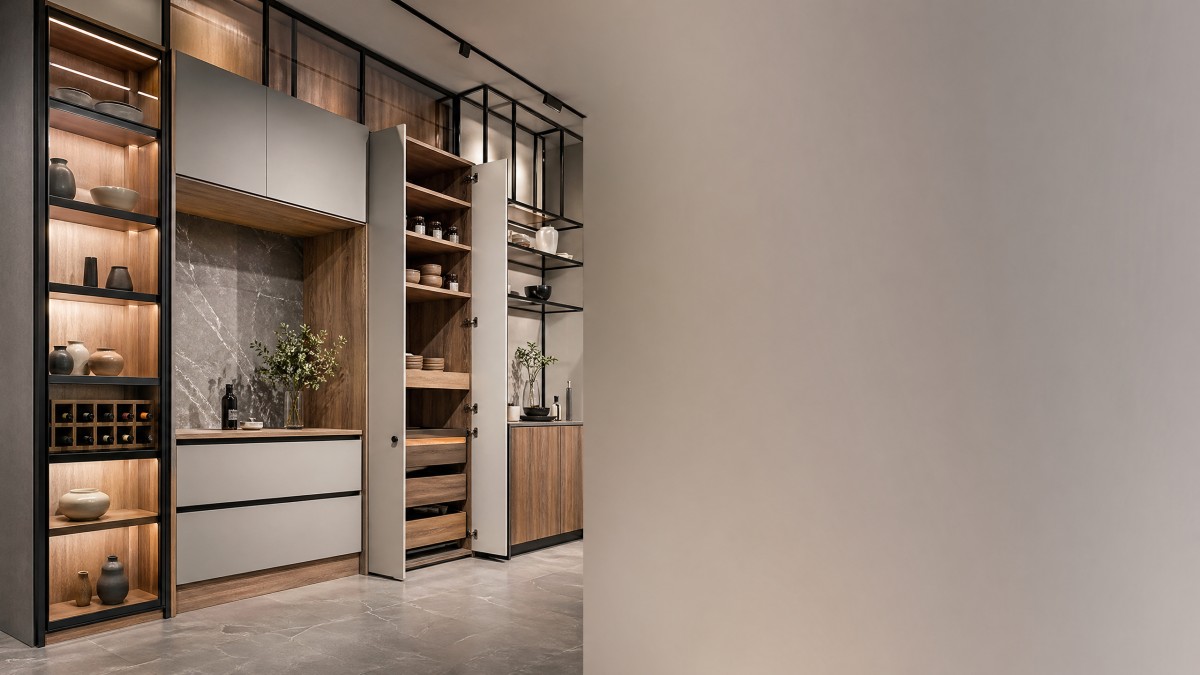
An open cabinet custom design is a cabinet system that leaves part or all of the storage area visible instead of fully enclosed by doors. In practical terms, this may include open shelving, mixed open-and-closed modules, display compartments, floating units, or metal-and-board framing structures. The design objective is usually to improve accessibility, create a more open visual rhythm, and reduce heavy wall coverage in the space.
For procurement managers and project leaders, the first planning step is to define the use scenario. A showroom pantry and a high-frequency apartment kitchen may both use open cabinets, but the performance expectations are different. In a display-driven environment, visual consistency and material finish may rank first. In a working kitchen, load-bearing capacity, cleaning convenience, moisture resistance, and installation accuracy often become the top 4 decision factors.
Open cabinet solutions are especially suitable for projects where the available wall area is limited or where the design language favors minimalism. In compact spaces of 6 to 12 square meters, open cabinets can visually reduce enclosure and make circulation feel less crowded. In larger commercial spaces, they can divide functions without building full partitions, which helps maintain sightlines and supports modern architectural layouts.
Typical B2B Use Cases
Project buyers should evaluate whether the open cabinet is intended for daily storage, decorative display, retail presentation, or mixed use. This affects the structure, hardware, material thickness, and even packaging method during export. A design that works well for sample display may not be ideal for humid bathroom zones or for rental units with frequent turnover.
- Residential and apartment kitchens that need quick access to dishes, spices, or small appliances.
- Wardrobe and dressing spaces where open sections are used for bags, folded clothing, or decorative lighting.
- Bathroom vanity combinations where open lower shelves improve convenience for towels and dry storage.
- Commercial interiors such as office tea rooms, hospitality suites, and retail display areas.
Before choosing specifications, it helps to compare common open cabinet project directions. The table below gives a clear planning reference for different applications in building decoration projects.
The main conclusion is that open cabinet design should not be treated as a fixed style formula. The right open ratio depends on traffic level, maintenance expectations, and end-user behavior. In most project kitchens, a mixed solution with 65% to 80% closed storage and selective open shelving gives a better balance between aesthetics and long-term usability.
Choose Materials, Structure, and Finishes for Long-Term Performance
Material selection has a direct impact on durability, cost, installation stability, and after-sales risk. Since open cabinet sections remain visible, the edge quality, board surface consistency, and color tolerance are more noticeable than in closed systems. This means buyers should evaluate both decorative performance and structural reliability from the early quoting stage.
For most building decoration projects, common cabinet substrate options include particle board, plywood, and MDF, usually with melamine, laminate, lacquer, or veneer finishes depending on the target price level. In open cabinet custom design, the board thickness often falls within 16 mm to 18 mm for general shelving, while heavy-duty shelves or long-span open sections may require stronger internal support or thickness adjustment to reduce deflection over time.
Humidity exposure must also be considered. Bathroom vanities and coastal projects often need better moisture resistance than dry wardrobes or office pantries. In these cases, sealing quality on edges and cut surfaces becomes critical because open compartments expose more board ends and corners to daily cleaning and environmental fluctuation. Even a visually attractive design can create warranty issues if the wrong substrate is selected for a high-moisture zone.
Key Technical Points Buyers Should Check
When comparing suppliers, procurement teams should not focus only on finish samples. They should also ask how the cabinet system performs under repeated use, transport handling, and installation alignment. For export projects, packaging method and panel labeling can be just as important as the cabinet itself because they affect site efficiency and damage rates.
- Board thickness and support span for open shelves, especially over 800 mm in length.
- Edge banding consistency, corner finishing, and resistance to chipping during transport.
- Surface selection based on cleaning frequency, fingerprint visibility, and abrasion level.
- Hardware compatibility for mixed open-and-closed units, including concealed supports and connectors.
The comparison below can help decision-makers match material choices with common project conditions and budget tiers.
A practical takeaway is to align material choice with lifecycle expectations. If the project is designed for 3 to 5 years of frequent use, standard commercial specifications may be sufficient. If the target service period is 8 to 10 years, stronger substrates, more stable finishes, and better detailing around exposed edges usually offer better value despite a higher initial unit price.
Plan Storage Layout, Dimensions, and Installation Details Early
A successful open cabinet custom design depends heavily on layout planning. Many project problems come from insufficient dimensional coordination rather than from the cabinet materials themselves. Procurement teams should ask for a clear breakdown of base units, wall units, open modules, filler panels, toe kicks, and hardware positions before production starts. This reduces change orders, avoids on-site cutting, and improves installation speed.
In kitchen and pantry applications, the open sections should be planned according to the frequency of use. Daily items such as cups, plates, or coffee accessories are better placed between 900 mm and 1600 mm from the finished floor, where users can reach them comfortably. Decorative or less frequently used items can be placed higher. Lower open modules must account for cleaning access and should not create dust traps in tight corners.
Load planning is equally important. Even if an open shelf looks simple, it may carry 10 kg to 25 kg depending on its purpose. Long shelves without reinforcement can sag over time, especially when the span exceeds typical safe limits. Installers and project supervisors should check fixing conditions on concrete walls, block walls, or light partitions because anchoring methods vary by substrate and affect the final safety margin.
Recommended Planning Workflow
A structured workflow helps control both schedule and accuracy. In multi-unit developments or distribution-based supply, repeatable dimensions and standardized modules can improve output and reduce communication gaps between design, factory, and site teams.
- Confirm the room dimensions, ceiling height, plumbing, electrical points, and finished wall condition.
- Define the ratio of open and closed storage according to user behavior and project positioning.
- Select module sizes, shelf thickness, support details, and finish combinations.
- Review shop drawings, installation sequence, and packaging labels before mass production.
- Carry out sample approval or mock-up verification when the project involves repeated units.
Common Planning Mistakes
One frequent mistake is using too many open shelves in a high-traffic kitchen. This can make the space harder to maintain and reduce practical storage quality. Another issue is ignoring appliance dimensions, especially microwaves, compact ovens, or under-counter devices. A difference of 10 mm to 20 mm in planning can result in major site adjustments and delayed handover.
Project managers should also avoid finalizing cabinet production before confirming flooring thickness, wall tile build-up, and service outlet positions. These details influence finished dimensions and can affect door alignment, shelf levelness, and filler width. In export projects, a pre-production review meeting often saves 1 to 2 weeks of rework risk later in the schedule.
Control Budget, Lead Time, and Procurement Risk in Custom Cabinet Projects
For distributors, contractors, and engineering buyers, an open cabinet custom design must be commercially viable as well as visually attractive. Budget control depends on several variables: material grade, finish process, structural complexity, hardware selection, order quantity, and packing method. Open cabinets may reduce door and hinge costs, but they can increase finishing requirements because more surfaces remain visible.
Lead time should be evaluated in stages rather than as a single number. A typical project may include 3 main phases: design confirmation, production, and shipping preparation. Depending on complexity and volume, sample confirmation may take 7 to 15 days, production may take 20 to 35 days, and export packing plus loading preparation may require another 3 to 7 days. Clear approval checkpoints help avoid timeline disputes.
Risk control is especially important when supplying repeated units across apartments, villas, or commercial rooms. Small drawing errors can multiply into large losses. That is why many professional buyers use a checklist covering at least 6 items: dimensions, finish code, substrate type, hardware list, packaging label logic, and installation drawing consistency. A reliable supplier should be able to support these checkpoints with organized documentation.
Procurement Evaluation Matrix
The table below can be used by procurement teams when comparing open cabinet suppliers for project supply or channel distribution.
The most important insight is that supplier selection should be based on process capability, not only on the initial quotation. A lower price can become more expensive if it leads to drawing revisions, shipment delays, or installation issues. Buyers managing multiple stakeholders often gain better long-term results from suppliers that combine design coordination, production control, and export experience in one workflow.
Work With a Supplier That Can Support Design, Production, and Delivery
Open cabinet custom design projects become easier to manage when the supplier can connect concept development with factory execution. This is particularly valuable for builders, design companies, and distributors handling multiple SKUs or repeated room types. Instead of separating design review, production communication, and export coordination across different parties, an integrated approach shortens decision cycles and improves accountability.
Kucu supports this process through combined manufacturing, design, and export capabilities. With a 40,000 square meter manufacture center and 8 production lines, the company is positioned to support both custom development and repeated project supply. For cabinet categories such as kitchen cabinets, wardrobes, and bathroom vanities, this combination helps clients maintain consistency across finish selection, structural logic, and packaging preparation.
For distributors and agents, supplier cooperation is not only about current product sourcing. It is also about how easily new designs can be adapted to local market demands, price targets, and installation preferences. A partner experienced in customized cabinet export can help optimize unit configuration, simplify installation steps, and reduce communication gaps during order execution.
FAQ for Buyers and Project Teams
How much open storage is practical in a custom cabinet project?
In most kitchen and residential projects, keeping open storage within 20% to 35% is practical. For retail display or hospitality styling zones, the ratio can increase to 50% or more. The right level depends on cleaning frequency, user behavior, and the need for concealed storage.
What should project managers check before approving production?
At minimum, confirm 6 points: final dimensions, finish references, substrate type, shelf support details, appliance and service coordination, and packaging labels. If the project includes repeated units, a sample or mock-up review is strongly recommended before mass production.
How long does a custom open cabinet order usually take?
For many B2B projects, design confirmation may take 1 to 2 weeks, production 3 to 5 weeks, and loading preparation several additional days. The exact cycle depends on quantity, material complexity, revision frequency, and destination market requirements.
Are open cabinets suitable for humid spaces?
Yes, but only when material and edge protection match the environment. Bathroom vanity and laundry-related spaces generally require better moisture-resistant boards, sealed edges, and careful ventilation planning. Open storage should be placed away from direct splash zones whenever possible.
A well-planned open cabinet custom design brings together aesthetics, storage logic, structural durability, and procurement efficiency. For builders, project managers, distributors, and design firms, the best results come from early layout planning, appropriate material selection, clear dimensional control, and a supplier that can support both production and export execution.
If you are sourcing kitchen cabinets, wardrobes, or bathroom vanities for residential or commercial projects, Kucu can help you evaluate configurations, optimize specifications, and develop a practical custom solution for your market. Contact us today to get a tailored cabinet proposal, discuss product details, or explore more building material solutions for your next project.