

Avoiding costly errors in open cabinet custom design starts with understanding how layout, materials, storage needs, and project budgets work together. For procurement teams, project managers, and distributors, the right design decisions can improve functionality, visual appeal, and long-term value. This guide highlights common mistakes to avoid and helps you plan smarter cabinet solutions for residential and commercial projects.
In the building decoration materials sector, open cabinet systems are widely used in kitchens, wardrobes, display storage, and bathroom vanity projects. Their visual lightness and easy access appeal to both residential developers and commercial fit-out teams. However, open cabinet custom design requires more discipline than many buyers expect, because appearance, durability, installation accuracy, and end-user behavior must all be considered from the beginning.
For buyers working on multi-unit housing, hospitality interiors, renovation packages, or dealer distribution, a design mistake is not only a style issue. It can lead to material waste, delayed installation, client complaints, and higher after-sales costs. Suppliers with integrated design, manufacturing, and export support, such as Kucu Building Materials Co., Ltd. in Foshan, can help reduce these risks by aligning production details with real project conditions.
Poor Space Planning Is the First and Most Expensive Mistake
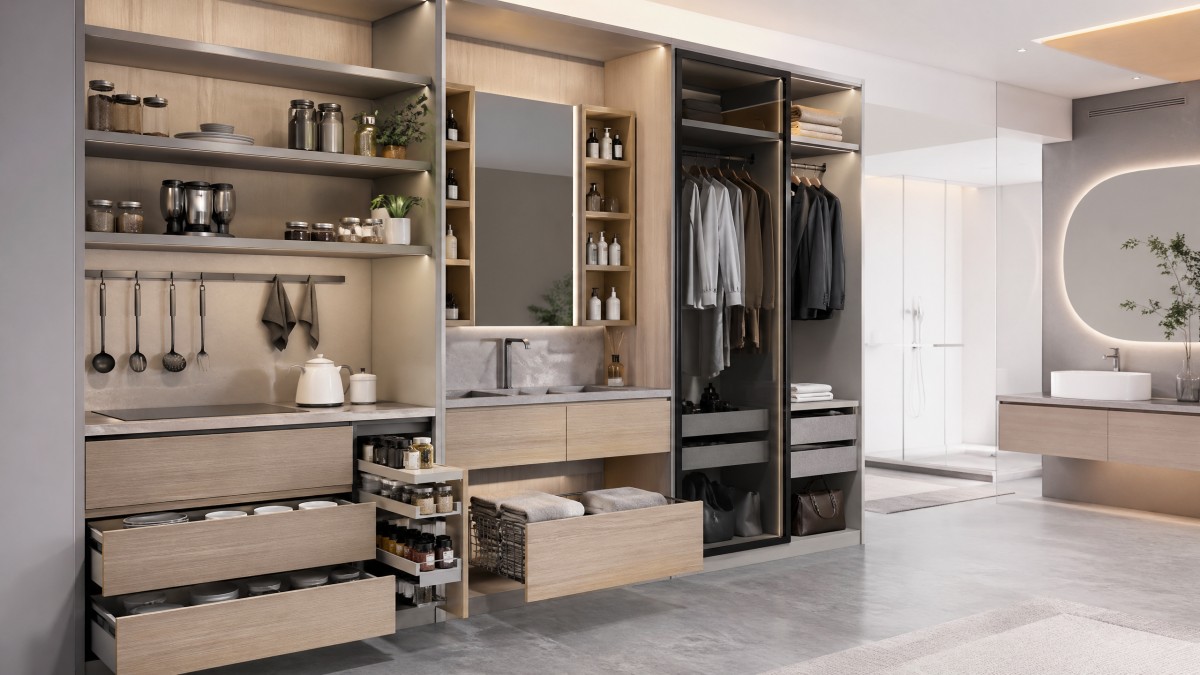
Open cabinets look simple on drawings, but poor space planning quickly creates operational problems on site. In kitchens, an attractive shelving layout may conflict with appliance doors, corner access, ventilation zones, or plumbing routes. In wardrobes and vanity areas, open sections that are too wide or too shallow often reduce usable storage instead of improving it.
A common error is designing only for elevation aesthetics rather than movement and reach. For example, upper open shelves installed above 1600 mm may look balanced in renderings, but many users cannot comfortably access them without a stool. Likewise, shelves below 250 mm depth may not support standard dinnerware, folded garments, or display baskets efficiently.
Project managers should also pay attention to clearance zones. In practical cabinet design, at least 900 mm of working aisle is often preferred in kitchens, while 1000-1200 mm can be safer in higher-traffic or dual-user spaces. If open cabinet layouts are planned before confirming equipment dimensions, the final installation may force costly rework in panels, hardware, or countertop alignment.
Key Planning Gaps That Cause Rework
- Ignoring appliance and door swing requirements, especially around ovens, refrigerators, and tall units.
- Using uniform shelf spacing when actual storage categories need 220 mm, 320 mm, or 380 mm clear heights.
- Failing to coordinate cabinet depth with walls, columns, skirting lines, and electrical points.
- Overusing open units in dust-prone or high-humidity environments without maintenance planning.
Before locking production drawings, procurement and design teams should verify at least 4 dimensions: total wall length, finished floor-to-ceiling height, service point locations, and clearance between adjacent furniture or equipment. Even a 10-15 mm site variation can affect filler panels, shelving symmetry, or exposed edge alignment in open cabinet designs.
The table below shows common planning errors and the practical design responses that help avoid them during custom cabinet development.
The main lesson is simple: open cabinet custom design should start with measured function, not visual assumptions. When planning dimensions around daily use, site conditions, and access comfort, buyers can reduce installation risk and improve user satisfaction across both standard and customized projects.
Choosing the Wrong Materials for Open Cabinet Applications
Material selection is one of the most underestimated factors in open cabinet projects. Because the shelves, side panels, and exposed edges remain visible, any weakness in substrate stability, edge treatment, or finish performance becomes obvious over time. In closed cabinets, some wear stays hidden. In open cabinet systems, every surface is on display every day.
For kitchen cabinets and bathroom vanity units, moisture resistance is especially important. If the board type is selected only by price, swelling, edge lifting, or surface deterioration may appear within 6-18 months in humid conditions. In projects near cooking zones, heat and steam exposure also accelerate damage if finishes are not chosen appropriately.
Procurement teams should compare material options based on environment, expected load, and maintenance frequency. Open shelves holding ceramics, appliances, or display stock need better load stability than decorative niches. In many practical applications, shelf spans above 800-900 mm require reinforcement or a thicker board to reduce visible deflection under long-term weight.
Material Factors That Deserve Closer Review
Substrate Performance
The choice between particle board, plywood, and MDF-based solutions should reflect the project setting. Particle board can be cost-efficient for dry indoor zones, while better moisture resistance may be needed for kitchens and bathroom cabinetry. The key is not to assume one board type fits all spaces.
Surface Finish Durability
Open cabinet surfaces are more likely to face direct touch, frequent wiping, and visual inspection. Matte, woodgrain, lacquer-like, or laminate finishes should be evaluated for scratch visibility, cleanability, and consistency across batches. For distributor and dealer channels, finish stability matters because replacement panels from later orders should remain visually close to the original shipment.
The following table helps compare material considerations commonly used in customized cabinet projects.
For B2B buyers, the right material choice supports both cost control and reputation control. A cabinet line that performs well for 3-5 years in real use usually creates fewer claims than a lower-priced option that leads to visible defects after one seasonal cycle. This is why material review should be connected to project environment, not only procurement budget.
Ignoring Storage Behavior and User Scenarios
Another major mistake in open cabinet custom design is assuming all users organize and maintain spaces in the same way. In reality, a display-driven apartment showroom, a rental housing unit, a family kitchen, and a serviced apartment pantry all require different open storage strategies. If usage is misunderstood, the final design may look clean on day one but become cluttered within weeks.
Open cabinet planning should begin with item categories and frequency of use. Daily access items need easier reach and more forgiving shelf spacing, while occasional-use items may be placed higher. In a wardrobe system, for example, open cubbies for folded clothes often work best in the 300-400 mm height range, while display niches may use smaller modular repetition for visual order.
For developers, builders, and design companies, balancing open and closed storage is often more effective than maximizing one style. A practical ratio in many residential cabinet projects is not 100% open shelving. Instead, a controlled mix can improve appearance while limiting dust exposure and visual overload.
Questions Buyers Should Ask Before Confirming Design
- What items will the user store here: plates, pantry containers, towels, display goods, or folded garments?
- How often will the shelves be cleaned: daily, weekly, or only during turnover cycles?
- Will the project prioritize styled presentation, high-capacity storage, or fast handover maintenance?
- Is the cabinet for owner-occupied use, rental use, hospitality use, or resale distribution?
When these questions are skipped, open shelving may become a liability. In kitchen projects, buyers often request wide uninterrupted shelves for visual openness, but actual users may need dividers, tray storage, or concealed sections to keep the space orderly. The same issue appears in vanity areas, where exposed storage may not suit every user’s daily products and cleaning habits.
Good cabinet suppliers translate user behavior into module logic. This may include dividing storage into 3 zones: high-frequency, medium-frequency, and reserve storage. It may also include specifying shelf loads, recommended basket accessories, or optional closed modules for mixed-use layouts. Such decisions improve long-term usability without sacrificing the open cabinet aesthetic.
Underestimating Budget, Production, and Installation Coordination
Open cabinet custom design can appear less expensive than fully enclosed cabinetry, but this is not always true. Because exposed components need better finish consistency, tighter panel tolerance, and cleaner installation lines, the labor and quality-control requirements may increase. Buyers who budget only by cabinet volume often underestimate the real cost drivers.
There are usually 4 cost layers to evaluate: board and finish selection, hardware and support structure, fabrication complexity, and installation accuracy. Open end panels, visible shelving joints, and decorative back panels may add production steps even when fewer doors are used. If the design includes integrated lighting, metal supports, or floating shelves, coordination becomes even more important.
Lead time planning is another area where avoidable mistakes happen. For export-oriented or project-based orders, cabinet supply often needs 3 major stages: drawing confirmation, manufacturing, and packing plus shipment coordination. If site measurement is delayed or design changes are made after production starts, project schedules can slip by 1-3 weeks depending on order size and revision scope.
Typical Procurement Review Points
Kucu Building Materials Co., Ltd., with a 40,000 square meter manufacturing center and 8 production lines, is positioned to support customized cabinet supply for builders, design companies, decoration companies, and building owners. For B2B buyers, this integrated capability matters because design communication, production control, and export handling affect total project efficiency more than unit price alone.
The table below outlines practical budget and delivery factors that should be reviewed before placing an open cabinet order.
The key takeaway is that open cabinet projects should be quoted and scheduled as precision visible systems, not simplified furniture lines. When buyers evaluate design complexity, finish visibility, and installation conditions early, they usually gain better cost predictability and smoother project delivery.
How to Build a Safer Open Cabinet Design Process
The best way to avoid open cabinet custom design mistakes is to use a clear review process before manufacturing begins. This process should connect procurement, design, production, and installation teams. In many successful projects, the design review is handled in 5 steps rather than a single approval round.
A Practical 5-Step Control Method
- Confirm use scenario and storage behavior, including who uses the cabinet and what items are stored most often.
- Verify dimensions and site conditions, with special attention to floor level, wall straightness, and service points.
- Select substrate, finish, and edge details based on humidity, cleaning frequency, and load expectations.
- Review installation logic, including support methods, visible joint alignment, and tolerance allowances.
- Approve packing, labeling, and after-sales service scope before shipment or site dispatch.
This method is especially useful for distributors and project managers handling repeated cabinet models across multiple units. Standardizing 6-8 key checkpoints can reduce avoidable variation between rooms, buildings, or batches. It also helps purchasing teams compare suppliers using the same decision framework rather than relying only on sample appearance.
A reliable cabinet partner should be able to support customization in kitchens, wardrobes, and bathroom vanity systems while also explaining how each design choice affects production and use. This is where integrated manufacturers can add value: they connect design intent with fabrication reality, helping buyers reduce hidden risks before they become site issues.
FAQ: How long does open cabinet project delivery usually take?
Timing depends on design complexity, quantity, and export arrangements. For many customized cabinet orders, buyers should allow time for drawing confirmation, manufacturing, inspection, and logistics coordination. If measurements or finishes remain uncertain, lead time pressure increases quickly.
FAQ: What should dealers and distributors check first?
Start with finish consistency, modular flexibility, packaging clarity, and replacement convenience. Open cabinet products are visually exposed, so edge quality, board stability, and repeat-order color control are critical for channel credibility.
FAQ: Are open cabinets suitable for all projects?
Not always. They work well in curated residential spaces, display-oriented interiors, and mixed storage layouts. In high-dust, high-grease, or low-maintenance environments, a hybrid solution with both open and closed modules is often the safer specification.
Avoiding mistakes in open cabinet custom design depends on disciplined planning across layout, materials, user behavior, budget, and delivery coordination. For procurement professionals, project leaders, and distribution partners, the strongest results usually come from balancing visual openness with measurable functionality and realistic installation conditions.
Kucu Building Materials Co., Ltd. brings 20 years of customized cabinet supply experience, along with production, design, and export capabilities for kitchen cabinets, wardrobes, and bathroom vanity solutions. If you are evaluating cabinet options for residential or commercial projects, contact us now to get a tailored design proposal, discuss product details, and explore practical solutions that fit your project goals.