
Open cabinet custom design works best when projects need a balance of visual openness, flexible storage, and cost control. For builders, project managers, and distributors, this approach can improve space efficiency while supporting modern interior trends. With the right materials, layout, and manufacturing partner, open cabinet custom design can deliver both practical value and strong market appeal.
In the building decoration materials sector, open cabinet systems are no longer limited to boutique homes or display spaces. They are now widely considered in apartments, serviced residences, model units, retail-backed living concepts, and light commercial interiors where appearance, access, and budget must be carefully balanced.
For procurement teams, the decision is rarely only about style. It involves material selection, moisture resistance, manufacturing precision, installation speed, export packing, and long-term maintenance. For project leaders, the challenge is choosing a cabinet solution that looks modern while remaining practical across dozens or even hundreds of units.
Kucu Building Materials Co., Ltd., based in Foshan, Guangdong, operates a 40,000 square meter manufacturing center with 8 high-configuration production lines. With 20 years of experience in customized cabinets and integrated capabilities in production, design, and export, the company supports builders, design firms, decoration companies, and building owners with kitchen cabinets, wardrobes, and bathroom vanities tailored to project needs.
Where Open Cabinet Custom Design Delivers the Best Results
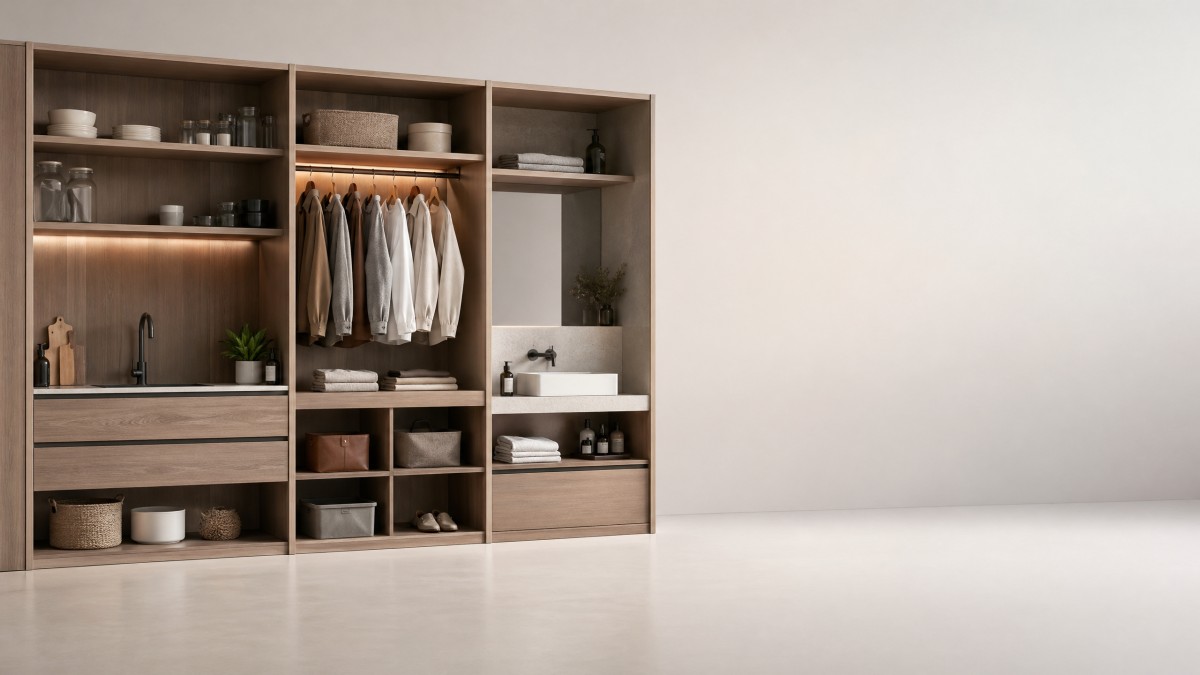
Open cabinet custom design performs best in projects where space perception matters as much as storage. In compact units of 45–90 square meters, removing some solid cabinet doors can make kitchens, wardrobes, and vanity areas look larger and less visually heavy. This is especially useful in urban residential developments and furnished rental units that rely on efficient layouts.
It is also a strong fit for spaces that need fast access and display value. In sample rooms, branded apartments, hospitality suites, and retail-inspired interiors, open shelving or partially open cabinet sections help show material texture, tableware, decorative items, folded linens, or premium accessories. This visual function often improves the perceived quality of the interior without requiring a fully high-end budget.
From a project management perspective, open cabinet design can simplify some hardware needs. A fully closed cabinet layout may require more hinges, lift systems, and door alignment work. By reducing the number of doors in selected zones, teams can cut certain accessory costs and reduce installation adjustment time by 10%–20% in standard configurations, depending on unit type and module repetition.
Typical project scenarios
The best applications usually share three features: limited floor area, a need for a modern visual identity, and controlled usage conditions. Open cabinet custom design is less ideal in environments with heavy dust, high grease exposure, or inconsistent maintenance. In contrast, it performs well in managed residential projects, display units, and organized storage zones.
- Apartment projects with repeated unit plans that benefit from standardized module production.
- Wardrobe systems in bedrooms where open compartments improve daily access to folded garments or display items.
- Bathroom vanity side storage where towels and toiletries are arranged for easy reach, provided moisture-resistant boards are specified.
- Model homes and showroom spaces where visual merchandising is part of the sales strategy.
For distributors and agents, this design direction also creates a clear product story. Instead of competing only on basic door panel pricing, open cabinet systems allow value-based selling around layout flexibility, decorative integration, and mixed-function storage. That can be useful in markets where standard closed cabinetry has become highly price-driven.
The table below shows where open cabinet custom design typically works best compared with more fully enclosed solutions.
The key conclusion is that open cabinet custom design is most effective when the project has predictable user behavior, a defined visual target, and material choices suited to the environment. It should be treated as a strategic mix of open and closed storage, not as a one-style-fits-all solution.
Material and Structural Choices That Matter Most
Because open cabinet systems expose more of the internal structure, material quality becomes more visible than in a fully closed cabinet. Buyers should pay close attention to board surface consistency, edge banding precision, thickness selection, and color stability. In many projects, panel thickness options such as 16 mm and 18 mm are common, while shelves carrying heavier items may require stronger support planning or shorter spans.
For kitchen cabinets, open sections should generally be placed in low-grease zones such as pantry areas, breakfast corners, or side shelving. In bathroom vanity applications, moisture-resistant boards, sealed edges, and durable finishes are more important than decorative trends. A design that looks attractive in a rendering may fail quickly if the substrate and edge treatment are not suited to humidity cycles.
Surface finish selection also affects maintenance and market perception. Matte melamine, textured laminate, painted finishes, and wood-grain surfaces each create different outcomes. For high-volume project supply, buyers often favor finishes that balance visual appeal with stable lead times and manageable replacement matching in case of post-installation damage.
Core material checkpoints for project procurement
When evaluating suppliers, procurement teams should compare not only visible samples but also structural details that influence daily performance and after-sales risk.
- Board suitability: confirm whether the substrate matches kitchen, wardrobe, or bathroom usage conditions.
- Edge banding quality: exposed open cabinet edges must be clean, tight, and consistent because they remain visible from multiple angles.
- Shelf load planning: long open shelves need practical span limits and reinforcement planning, especially in units intended for everyday storage.
- Color consistency: batch control matters in projects with 50, 100, or more repeated units.
- Hardware integration: even open systems still depend on concealed connectors, leveling parts, drawer runners, and hanging accessories.
Why precision affects open cabinet design more directly
In a closed cabinet, small alignment variation can be hidden behind doors. In an open cabinet, uneven shelf lines, rough cut edges, and poor joint transitions are immediately visible. That makes manufacturing precision especially important. Project teams should review sample craftsmanship and production tolerance control early, before approving large-volume orders.
A supplier with integrated design, production, and export coordination can also reduce communication loss between drawing approval and final packaging. This matters when projects involve overseas shipment, phased delivery, or multiple cabinet categories such as kitchens, wardrobes, and bathroom vanities within the same order schedule.
The following table outlines common material and structural considerations for open cabinet custom design in different interior zones.
For most buyers, the most practical approach is not choosing the most expensive finish, but choosing the most suitable material combination for each use area. Open cabinet custom design succeeds when appearance, environment, and expected maintenance level are considered together.
How Builders and Project Managers Should Evaluate Layout Efficiency
Layout planning is the point where design intent turns into measurable project value. Open cabinet custom design should improve circulation, access, and storage behavior rather than only create a fashionable look. In residential projects, a well-planned cabinet run can reduce visual crowding and help users reach high-frequency items within 1–2 movements instead of opening multiple compartments.
A balanced layout often mixes open and closed zones. Open sections are usually most effective for display, quick-access storage, or lightweight daily-use items. Closed compartments are still better for bulky goods, cleaning supplies, mixed household items, and spaces where a neat appearance must be maintained with minimal user discipline. This hybrid strategy is often the most durable option for large-scale developments.
For kitchens, designers should think in task zones: preparation, washing, cooking, and storage. Open shelving near preparation areas can support bowls, dry goods, or decorative items, while the cooking zone usually benefits from more closed storage due to grease exposure. For wardrobes, open compartments should be located at frequently used heights, while upper areas can remain closed for seasonal items.
Four layout questions before final approval
- What percentage of the cabinet should remain open? In many practical projects, 20%–40% open exposure is easier to manage than a fully open system.
- Which items will actually be stored there? Daily-use objects, folded textiles, and display pieces suit open shelves better than irregular or unattractive bulk storage.
- Does the user profile support visible storage? A model unit and a family apartment may need different open-to-closed ratios.
- Can installation teams maintain alignment across repeated units? Even a 2–3 mm visible variation can affect the finished look in exposed shelving lines.
Common planning mistake
One common mistake is copying a showroom-style design into a high-usage residential project without adapting the storage logic. Showroom cabinets are curated and rarely used under real daily conditions. A project-ready open cabinet layout needs a stronger focus on cleaning access, practical shelf depth, item size compatibility, and visual order after move-in.
Another mistake is ignoring installation sequence. In large projects, cabinet installation may be coordinated with flooring, backsplash work, lighting, stone tops, and plumbing. A custom supplier that can review drawings early and anticipate tolerance interfaces helps reduce site adjustment issues during the final 7–14 days before handover.
For project managers, layout efficiency should be discussed in relation to unit repetition, labor coordination, and replacement planning. If open modules are standardized well, they can support repeatable production and easier accessory replenishment across future phases.
Procurement Criteria, Lead Time, and Supply Coordination
When selecting an open cabinet custom design supplier, B2B buyers should evaluate the full supply chain rather than only the quotation sheet. Cabinet projects involve design confirmation, material sampling, production scheduling, hardware sourcing, packing protection, export documentation, and installation coordination. Weakness in any one stage can affect cost and site progress.
A supplier with combined production, design, and export experience can be especially valuable for overseas projects or mixed-product orders. Kucu’s manufacturing base in Foshan, with 8 production lines and a 40,000 square meter facility, is relevant to buyers who need both customization and batch consistency. Capacity alone does not guarantee project success, but integrated handling can support more stable communication from drawing to delivery.
Typical lead time depends on design complexity, quantity, finish selection, and order sequencing. For standard project configurations, sample confirmation may take 7–15 days, while mass production often falls within several weeks after final drawing approval. Buyers should always confirm whether the lead time includes hardware preparation, special finish sourcing, and export packing.
A practical supplier evaluation framework
The table below provides a practical decision framework for procurement personnel, distributors, and project coordinators comparing potential cabinet suppliers.
The biggest takeaway is that open cabinet custom design should be sourced as a project system, not as isolated cabinet boxes. The right supplier helps align design intent, production feasibility, packing logic, and handover timing. This becomes more important when one order includes kitchen cabinets, wardrobes, and bathroom vanities under the same specification package.
Checklist before purchase order release
- Approve open-to-closed cabinet ratios for each room type.
- Confirm board type and finish use by area, especially kitchens and bathrooms.
- Check repeated unit dimensions and any site tolerance limits.
- Review packing labels and installation sequence for phased delivery.
- Clarify spare parts, replacement policy, and after-sales response expectations.
Common Risks, Maintenance Needs, and FAQ for Buyers
Open cabinet custom design offers clear visual and operational benefits, but it also introduces specific risks that buyers should address in advance. The most common issues are dust accumulation, visible clutter, overextended shelf spans, and unsuitable material use in wet or greasy zones. These are manageable when design intent is matched with realistic usage conditions.
Maintenance planning should be included during specification review, not after installation. In managed residences or commercial-living projects, cleaning frequency may range from daily in display areas to weekly in standard use spaces. Finishes with easy-wipe surfaces and sensible shelf depth can reduce labor burden over time. For distributors, clear maintenance guidance also supports better customer satisfaction after delivery.
Another risk is over-design. If too many open modules are added simply to follow a trend, the result may be impractical for actual residents or end users. A functional ratio and room-by-room review are more important than applying the same solution across every cabinet elevation.
Risk control points
- Keep open shelves out of direct splash and heavy grease zones where possible.
- Limit shelf lengths or add support where load may increase over time.
- Define intended storage categories during design review to avoid unusable spaces.
- Use finish and edge specifications appropriate to kitchen, wardrobe, or vanity conditions.
How do I know if open cabinet custom design suits my project?
It is usually a good fit when the project values modern visual openness, repeated unit efficiency, and selective display storage. It works especially well in apartments, wardrobes, and styled bathroom areas where 20%–40% of the storage can remain visible without creating disorder.
What should procurement teams inspect first?
Start with three areas: substrate suitability, exposed edge quality, and dimensional consistency. Because open cabinets reveal more structural detail, these factors affect both appearance and service life more directly than in fully closed cabinet systems.
How long does a custom cabinet project usually take?
Timeframes vary by quantity and complexity, but a practical schedule often includes 7–15 days for drawing and sample confirmation, followed by several weeks of production after final approval. Overseas projects should also allow time for export packing and shipping coordination.
Is open cabinet design more cost-effective?
It can be, but not automatically. Savings may come from reduced door and hinge use in selected areas, while costs may rise if higher finishing standards are needed on visible internal surfaces. The most cost-effective strategy is usually a hybrid design that places open sections only where they add clear functional or visual value.
For builders, project managers, distributors, and sourcing teams, the best open cabinet custom design is not the most dramatic one. It is the one that fits the room type, material environment, maintenance routine, and budget target with the fewest downstream problems.
With 20 years of customization experience, integrated production, design, and export support, and a broad product range covering kitchen cabinets, wardrobes, and bathroom vanities, Kucu can help turn open cabinet concepts into practical project solutions. If you are planning a residential, commercial-living, or multi-unit interior project, contact us now to get a tailored cabinet solution, discuss product details, or explore a supply plan that matches your market and timeline.